Category: Treatments and procedures

What the treatments actually involve and what the evidence behind them shows: high-flow oxygen, nerve blocks, sphenopalatine ganglion blocks, Botox for chronic migraine, and IV therapy for an attack that will not break. Every injection here is placed under image guidance.

  • Greater and lesser occipital nerve: the anatomy that decides the injection

    There is more than one occipital nerve, they supply different territories, and which one is carrying your pain determines where the injection goes. Getting that wrong is one of the ordinary reasons a block does nothing.

    Three nerves, three territories

    • Greater occipital nerve. The main one, arising largely from the C2 nerve root. It emerges near the midline at the base of the skull and supplies the back of the head from there up and over toward the crown. Most of what is meant by an occipital nerve block targets this nerve.
    • Lesser occipital nerve. Arising from C2 and C3, running further out to the side. It supplies the area behind and above the ear. Pain that sits behind the ear rather than at the midline points here.
    • Third occipital nerve. From C3, supplying a small area low at the back of the head. It carries particular significance because it also innervates the C2-C3 facet joint, which makes it relevant when the neck joints are the source — see is my headache coming from my neck.

    How the territory maps to what you feel

    A useful exercise before your appointment is to trace the pain with a finger rather than describe it. Pain running from the base of the skull up over the back of the head, sometimes reaching the top or behind the eye, follows the greater occipital nerve. Pain sitting behind and above the ear follows the lesser. Both can be involved at once, which is why blocks are sometimes done at both sites — and how long that relief holds varies widely, see how long a block lasts.

    This is also why one-sided pain in this distribution, with tenderness over the nerve and shooting or electric-shock quality, raises occipital neuralgia rather than migraine — see occipital neuralgia or migraine.

    Why the head and the face share a pain system

    The reason a neck nerve can produce pain behind the eye is convergence. Sensory fibers from the upper cervical roots and from the trigeminal nerve, which supplies the face, meet in the same region of the brainstem — the trigeminocervical complex. Input arriving from the back of the head is processed alongside input from the front of it, and can be felt there.

    That anatomy is why blocking a nerve at the back of the head can help a headache felt at the front, which otherwise makes no sense at all.

    The artery that changes the technique

    The occipital artery runs alongside the greater occipital nerve. That single anatomical fact accounts for most of what is distinctive about doing this injection properly.

    A landmark technique locates the nerve by measuring from bony points — typically along the line between the occipital protuberance and the mastoid process. It is a reasonable estimate of where the nerve usually is, and both the nerve and the artery vary in position between people. Ultrasound shows both, in real time, with Doppler to distinguish vessel from nerve, and shows the needle advancing. See ultrasound and fluoroscopic guidance.

    So imaging is doing two jobs: keeping the injectate out of the artery — the main safety consideration, covered in side effects and risks — and making a negative result meaningful. Both matter — see why image guidance matters.

    Why this matters for your appointment

    If a previous block was placed at the standard greater occipital site and did nothing, the useful question is not only whether it was guided, but whether it was aimed at the right nerve. Pain behind the ear treated with a midline greater occipital block is a plausible reason for a genuine non-response. That is a fixable problem rather than evidence the approach does not work for you.

    Common questions

    Which occipital nerve is mine?

    It is worked out from where you trace the pain and where the tenderness is, then confirmed by the response to blocking it. Bring a clear description, or trace it on yourself at the visit — contact us to arrange one.

    Can both sides be blocked at once?

    Yes, bilateral blocks are routine where the pain is on both sides. See occipital nerve block.

    Why does blocking a nerve in my neck help pain behind my eye?

    Because upper cervical and trigeminal sensory fibers converge in the trigeminocervical complex, so pain from the back of the head can be felt at the front. It is the same convergence that makes neck involvement so common in migraine — see is my headache coming from my neck.

    Is the third occipital nerve blocked the same way?

    It is a different and more precise target, and it is usually relevant when the C2-C3 facet joint is the suspected source — which is a cervicogenic picture. See cervicogenic headache treatment.

    Sources

    1. Zhang H, Yang X, Lin Y, Chen L, Ye H. The efficacy of greater occipital nerve block for the treatment of migraine: a systematic review and meta-analysis. Clin Neurol Neurosurg. 2018;165:129-133. doi:10.1016/j.clineuro.2017.12.026
    2. Inan LE, Inan N, Karadaş Ö, et al. Greater occipital nerve blockade for the treatment of chronic migraine: a randomized, multicenter, double-blind, and placebo-controlled study. Acta Neurol Scand. 2015;132(4):270-277. doi:10.1111/ane.12393

    Being seen at Headache Express. We treat migraine, cluster and other severe headaches in St. Louis, usually the same day. Please contact us before coming in so the right treatment is ready when you arrive.

  • Steroid or anesthetic: what actually goes into an occipital nerve block

    Most people assume the steroid is the part that works and the anesthetic is just there to make the injection comfortable. The trial evidence points the other way, and it is worth understanding before you agree to a steroid you may not need.

    What is usually in the syringe

    An occipital nerve block is a local anesthetic — commonly lidocaine, bupivacaine, or both together, one fast and short-acting, the other slower and longer-lasting. A corticosteroid such as triamcinolone or methylprednisolone is sometimes added. Whether it should be is the interesting question.

    What happened when a trial tested exactly that

    A randomized, double-blind, placebo-controlled trial in episodic migraine without aura did the clean comparison, randomizing patients to four arms: triamcinolone alone, lidocaine alone, triamcinolone plus lidocaine, and saline.1

    Headache severity and duration fell significantly in all four groups, including saline, with no difference between groups. But when frequency was examined, only the two arms containing lidocaine showed a significant reduction from baseline.1 The steroid-only arm did not.

    Fifty-five patients completed that study, so it is not a large trial and it should not be treated as the final word. But the direction is consistent with the wider picture: the meta-analysis specifically assessing local anesthetics against placebo in chronic migraine found meaningful reductions in headache intensity and frequency in the first two months.2

    So why is a steroid added so often

    Partly reasoning by analogy from other injections, where steroid addresses an inflammatory process. Occipital neuralgia and cervicogenic headache may involve a genuinely irritated or entrapped nerve, and there the case for a steroid is more coherent than it is in migraine.

    Partly habit. It is what the local practice pattern has been, and it rarely gets revisited.

    What a steroid costs you

    • A facial flush for a day or two.
    • A transient rise in blood sugar, which matters if you are diabetic.
    • With repetition at the same site, thinning of the fat under the skin or a pale patch — visible at the back of the head, and not reliably reversible.
    • A practical limit on how often the injection can be repeated, which an anesthetic-only block does not have.

    In the four-arm trial, the only side effects reported were in patients who had received triamcinolone.1

    How this is decided here

    By what the block is for. For a purely diagnostic question — is this pain coming from this nerve — anesthetic alone is the cleaner test, because the answer arrives and departs on a known timetable rather than being blurred by a slow-acting drug. See do nerve blocks for headache work.

    Where there is a plausible inflammatory or entrapment component, a steroid may be added on that reasoning and reviewed by whether it actually bought anything. If two blocks with steroid and two without perform the same for you, that is your answer, and the steroid comes out.

    Common questions

    What steroid is used in an occipital nerve block?

    When one is used, usually triamcinolone or methylprednisolone. Whether one should be added at all is genuinely open — a four-arm randomized trial found the lidocaine-containing groups, not the steroid-only group, were the ones that reduced headache frequency.1

    Can I have the block without steroid?

    Yes, and for a diagnostic block that is often preferable. Say so at your appointment, or raise it when you get in touch.

    If the steroid is not doing much, why does the block work at all?

    The most likely explanation is the interruption of input into the trigeminocervical complex, where neck and head sensory pathways converge — which is an anesthetic effect, not a steroid one. See how long an occipital nerve block lasts.

    I am diabetic. Does that rule out a block?

    Not at all. It is a reason to prefer anesthetic alone, or to plan for a couple of days of higher readings if a steroid is used. Mention it before the injection — see side effects and risks.

    Sources

    1. Malekian N, Bastani PB, Oveisgharan S, Nabaei G, Abdi S. Preventive effect of greater occipital nerve block on patients with episodic migraine: a randomized double-blind placebo-controlled clinical trial. Cephalalgia. 2022;42(6):481-489. doi:10.1177/03331024211058182
    2. Mustafa MS, Bin Amin S, Kumar A, et al. Assessing the effectiveness of greater occipital nerve block in chronic migraine: a systematic review and meta-analysis. BMC Neurol. 2024;24(1):330. doi:10.1186/s12883-024-03834-6
    3. Zhang H, Yang X, Lin Y, Chen L, Ye H. The efficacy of greater occipital nerve block for the treatment of migraine: a systematic review and meta-analysis. Clin Neurol Neurosurg. 2018;165:129-133. doi:10.1016/j.clineuro.2017.12.026

    Being seen at Headache Express. We treat migraine, cluster and other severe headaches in St. Louis, usually the same day. Please contact us before coming in so the right treatment is ready when you arrive.

  • Can an occipital nerve block make a headache worse?

    Yes, temporarily, and it happens often enough that it is worth knowing in advance rather than discovering at ten o’clock that night. In almost every case it settles within a couple of days. The procedure itself is described on the occipital nerve block page. A small number of patterns should prompt a call instead.

    Why a worsening is common

    • Needle-site irritation. An injection into a tender, already-sensitized area produces soreness, and in someone with an active headache disorder that soreness can trigger the headache it was meant to treat.
    • The rebound as the anesthetic wears off. Several hours of relief ending abruptly can feel like a sharp worsening even when the pain has only returned to baseline. The contrast does the work.
    • Steroid flare. Where a corticosteroid was used, a flare of pain in the first 24 to 48 hours is a recognized effect of the crystalline suspension itself. It resolves. See steroid or anesthetic.
    • The drive home and the day itself. An appointment, a wait, a needle and a disrupted routine are a fairly efficient set of migraine triggers on their own.

    What is within the expected range

    Soreness at the injection site for one to three days. A headache on the day of the procedure or the day after, no worse in character than your usual attacks. A stiff feeling at the base of the skull. Numbness that wears off over several hours, then normal sensation returning.

    Note that trial data do not show more adverse events after occipital nerve block than after placebo injection.1,2 A bad night afterward is common; a lasting worsening is not.

    What should prompt a call

    • Pain that is still escalating after 72 hours rather than settling.
    • Fever, or spreading redness, warmth or swelling at the injection site — the reason this matters is set out in side effects and risks.
    • A new headache with neck stiffness that is worsening day by day.
    • Numbness or weakness that is not wearing off on the expected timetable.
    • Any of the warning signs in headache red flags, which are not specific to injections and always take precedence.

    The question underneath the question

    Often what people are really asking is whether a bad reaction means the treatment was wrong for them. It usually does not. The informative outcome is what happens over the following two to three weeks, not what happens that night.

    What does matter is whether the block was image-guided. A block placed by feel that produces pain and no benefit tells you very little, because you cannot know whether the injectate reached the nerve. A guided block that produces no benefit is a real result — see why image guidance matters.

    What helps in the meantime

    Ice rather than heat over the injection site for the first day. Your usual acute treatment, within your usual limits — and if you are close to those limits already, that is its own conversation, see medication-overuse headache. Tell us what happened at the next visit; a flare pattern changes what goes into the next injection.

    Common questions

    How long should the worsening last?

    Typically one to three days. Pain still escalating at 72 hours is worth a call rather than waiting it out — contact us.

    Does a flare mean the injection missed?

    Not on its own. A steroid flare in particular happens with correctly placed injections. Whether the target was reached is answered by the imaging, not by the flare — see ultrasound and fluoroscopic guidance.

    Should I take my usual migraine medication after the block?

    Generally yes, within your normal limits. If you are already treating on more days a month than is safe, raise it before the injection rather than after — see medication-overuse headache.

    Can I have another block if the first one flared?

    Often yes, and frequently without the steroid the second time. The decision is made on how the following weeks went — see how long a block lasts.

    Sources

    1. Zhang H, Yang X, Lin Y, Chen L, Ye H. The efficacy of greater occipital nerve block for the treatment of migraine: a systematic review and meta-analysis. Clin Neurol Neurosurg. 2018;165:129-133. doi:10.1016/j.clineuro.2017.12.026
    2. Mustafa MS, Bin Amin S, Kumar A, et al. Assessing the effectiveness of greater occipital nerve block in chronic migraine: a systematic review and meta-analysis. BMC Neurol. 2024;24(1):330. doi:10.1186/s12883-024-03834-6

    Being seen at Headache Express. We treat migraine, cluster and other severe headaches in St. Louis, usually the same day. Please contact us before coming in so the right treatment is ready when you arrive.

  • Occipital nerve block: side effects and risks

    Across randomized trials, adverse events after occipital nerve block have not differed significantly from placebo injections. That is a genuinely reassuring finding, and it is also not the same as saying nothing can go wrong.

    What the trial data show

    A meta-analysis of seven randomized controlled trials in migraine found no significant difference in adverse events between occipital nerve block and control, with a risk ratio of 0.93 (95% CI 0.52 to 1.65).1 A 2024 meta-analysis in chronic migraine reached the same conclusion, with the caveat that the number of studies and the sample sizes are small enough that rare events would not be detected.2

    That caveat matters. Trials of this size are good at telling you that common problems are uncommon. What the procedure itself involves is set out on the occipital nerve block page. They cannot tell you much about a complication that occurs once in several thousand procedures.

    Expected effects, not complications

    • Numbness over the back of the head on the treated side, wearing off with the anesthetic. This is the intended pharmacology.
    • A heavy or odd-feeling scalp for a few hours, sometimes described as the ear or the top of the head feeling strange.
    • Soreness at the injection site for a day or two.
    • A small bruise. The area is vascular.
    • Light-headedness immediately afterward, usually a response to the needle rather than the drug.

    The one that drives the technique: the occipital artery

    The occipital artery runs alongside the greater occipital nerve. That proximity is the single most important safety consideration, because an injection intended for the nerve can enter the artery instead. Local anesthetic delivered into an artery supplying the head is the mechanism behind the rare reports of seizure or transient neurological symptoms after this procedure.

    Ultrasound shows the artery and the nerve at the same time, with Doppler to confirm which is which, and shows the needle as it advances. This is why every injection here is placed under imaging rather than by surface landmarks — see ultrasound and fluoroscopic guidance. It is a safety argument before it is an accuracy argument.

    Rare but serious

    Infection is the one worth naming specifically. A case report describes occipital osteomyelitis and an epidural abscess developing 16 days after an occipital nerve block in a patient with no underlying medical conditions.3 The authors’ conclusion is the right one: the procedure is safe overall, and strict aseptic technique is not optional.

    Practically, that means a spreading redness, fever, or a headache and neck stiffness that is worsening rather than settling over the days after an injection is not something to wait out. Contact us, or if you are unwell, seek care the same day — see headache red flags.

    If a steroid is added

    Steroid brings its own small set of effects — a flush lasting a day or two, a transient rise in blood sugar that matters if you are diabetic, and with repetition, thinning or a pale patch of skin at the injection site. In one randomized trial, the only side effects reported were in patients who received triamcinolone.4 Whether a steroid is worth adding at all is a real question — see steroid or anesthetic.

    Common questions

    Can an occipital nerve block cause a stroke?

    This is a common worry and the honest answer is that stroke is not a recognized complication of the procedure. The relevant risk is inadvertent injection into the occipital artery, which can cause transient neurological symptoms or a seizure and is the reason the injection is done under ultrasound — see why image guidance matters.

    Is an occipital nerve block dangerous?

    On the trial evidence, adverse events do not differ significantly from placebo.1,2 The serious complications that exist are rare and are largely addressed by imaging and aseptic technique. It is a superficial injection that takes seconds.

    Will I need someone to drive me home?

    No. There is no sedation and you drive yourself home — see what to expect from an occipital nerve block.

    Can I drink alcohol afterward?

    There is no specific interaction with the injection itself. If a steroid was used and you are diabetic, watch your glucose for a couple of days. If you are unsure, ask us at the appointment.

    What should make me call you afterward?

    Spreading redness or swelling, fever, or a headache with neck stiffness that is getting worse rather than better over the following days.3 Ordinary soreness that improves is expected.

    Sources

    1. Zhang H, Yang X, Lin Y, Chen L, Ye H. The efficacy of greater occipital nerve block for the treatment of migraine: a systematic review and meta-analysis. Clin Neurol Neurosurg. 2018;165:129-133. doi:10.1016/j.clineuro.2017.12.026
    2. Mustafa MS, Bin Amin S, Kumar A, et al. Assessing the effectiveness of greater occipital nerve block in chronic migraine: a systematic review and meta-analysis. BMC Neurol. 2024;24(1):330. doi:10.1186/s12883-024-03834-6
    3. Christie SD, Kureshi N, Beauprie I, Holness RO. Occipital osteomyelitis and epidural abscess after occipital nerve block: a case report. Can J Pain. 2018;2(1):57-61. doi:10.1080/24740527.2017.1360725
    4. Malekian N, Bastani PB, Oveisgharan S, Nabaei G, Abdi S. Preventive effect of greater occipital nerve block on patients with episodic migraine: a randomized double-blind placebo-controlled clinical trial. Cephalalgia. 2022;42(6):481-489. doi:10.1177/03331024211058182

    Being seen at Headache Express. We treat migraine, cluster and other severe headaches in St. Louis, usually the same day. Please contact us before coming in so the right treatment is ready when you arrive.

  • How long does an occipital nerve block last?

    The honest answer is that the anesthetic wears off within hours, and the relief frequently does not. That gap between how long the drug lasts and how long the benefit lasts is the most confusing thing about this procedure, and it is also the most interesting thing about it.

    Two different clocks

    The local anesthetic itself is short-acting. Lidocaine gives a couple of hours; bupivacaine, which is longer-acting, gives several more. Numbness over the back of the head follows that same timeline and wears off with it.

    The therapeutic effect runs on a separate clock. In a multicenter double-blind placebo-controlled trial in chronic migraine, patients given bupivacaine blocks went from 18.1 headache days a month to 8.8 after a month of weekly blocks, against 16.9 to 13.2 in the saline group.1 That is a benefit measured in weeks from an injection that stopped being pharmacologically active the same day.

    Why relief outlasts the drug

    The working explanation is that the greater occipital nerve feeds into the trigeminocervical complex, where sensory input from the neck and the head converges. Interrupting a stream of input into a sensitized system appears to let it settle, and it does not immediately re-sensitize when the anesthetic clears. This is a mechanism argument rather than a proven pathway, and it should be read as the current best explanation rather than a settled one.

    What the range actually looks like

    Duration varies widely between people, and it is not predictable in advance from the diagnosis, the severity, or how well the injection went. Broadly:

    • Hours only. Relief that tracks the anesthetic exactly and then stops. Informative — it confirms the nerve is involved — but it is a diagnostic result more than a treatment.
    • Days to a few weeks. The most common pattern.
    • Months. Happens, and is more often reported when the underlying problem is occipital neuralgia or a cervicogenic pattern rather than migraine.
    • Nothing at all. Also informative, provided the injection was guided. See why image guidance matters.

    A caution about the averages

    Meta-analyzes consistently find that occipital nerve block reduces pain intensity and the number of headache days.2,3 They also find it does not shorten the duration of an individual headache.2,3 Those are different outcomes, and it is worth being clear which one you are hoping for: this treatment tends to reduce how often and how badly, rather than how long any single attack runs.

    How often it can be repeated

    There is no fixed course and no magic number. The interval is set by how long the previous block held and by clinical need, not by a protocol. If a block gives six weeks, repeating at six weeks is reasonable. If it gives four days, repeating it on a schedule is the wrong response and the question becomes whether the target is right.

    Where a steroid is added, that does place a practical limit on frequency — but the evidence that adding one helps at all is weaker than most people assume. See steroid or anesthetic.

    Common questions

    How long will my head feel numb?

    Usually several hours, tracking the anesthetic. Numbness over the back of the head on the treated side is the expected result of blocking that nerve, not a complication — see what to expect.

    My relief only lasted a day. Was it a failure?

    Not necessarily. A short but complete response confirms the nerve is carrying the pain, which is useful information. It does mean a plain repeat is unlikely to be the answer — talk to us about what it points toward.

    How soon can I have another one?

    There is no fixed schedule. It is timed by how long the last one held and by clinical need — see occipital nerve block.

    Will it stop an attack I am having right now?

    Sometimes, but that is not what it is best at. The trials show reductions in headache frequency and intensity rather than shortening of an individual attack.2,3 For an attack that will not break, see IV migraine therapy.

    Sources

    1. Inan LE, Inan N, Karadaş Ö, et al. Greater occipital nerve blockade for the treatment of chronic migraine: a randomized, multicenter, double-blind, and placebo-controlled study. Acta Neurol Scand. 2015;132(4):270-277. doi:10.1111/ane.12393
    2. Zhang H, Yang X, Lin Y, Chen L, Ye H. The efficacy of greater occipital nerve block for the treatment of migraine: a systematic review and meta-analysis. Clin Neurol Neurosurg. 2018;165:129-133. doi:10.1016/j.clineuro.2017.12.026
    3. Tang Y, Kang J, Zhang Y, Zhang X. Influence of greater occipital nerve block on pain severity in migraine patients: a systematic review and meta-analysis. Am J Emerg Med. 2017;35(11):1750-1754. doi:10.1016/j.ajem.2017.08.027

    Being seen at Headache Express. We treat migraine, cluster and other severe headaches in St. Louis, usually the same day. Please contact us before coming in so the right treatment is ready when you arrive.

  • What to expect from an occipital nerve block

    A small injection at the base of the skull, done sitting up, with no sedation. The needle part takes seconds. Most of the appointment is the conversation before it.

    Before

    We establish what we are treating and why, because the block is often diagnostic as well as therapeutic. Tell us where the pain starts, whether your scalp is tender to a hairbrush or a pillow, and whether neck position changes anything — those answers determine the target.

    Bring your medication list. You do not need to fast, you do not need a driver, and you can eat normally beforehand.

    During

    You sit leaning slightly forward. The landmarks are identified, the skin is cleaned, and we place the injection under ultrasound guidance — the occipital artery runs alongside the nerve, and ultrasound shows both so the needle can be steered around the vessel.

    A small volume of local anesthetic goes in, sometimes with a corticosteroid depending on what we are treating. The needle is fine. Most people describe pressure and a brief sting.

    After

    • Numbness over the back of the head on the treated side. Expected, and it wears off over several hours.
    • A heavy or odd-feeling scalp for the rest of the day.
    • Occasional light-headedness for a few minutes — we will have you sit before you stand.
    • Tenderness at the injection site for a day or two.

    You walk out and drive yourself home. There is no recovery period and no sedation to sleep off. Most people go back to work.

    What counts as a result

    Two things happen on different timescales, and they mean different things.

    The immediate effect — within minutes, while the anesthetic is working — is the diagnostic part. If the pain goes, that nerve was carrying it. If it does not, the pain is arising elsewhere and the diagnosis moves. See do nerve blocks for headache actually work.

    The durable effect is the therapeutic part. Relief frequently outlasts the anesthetic by weeks — longer than the pharmacology alone explains, probably because interrupting the pain signal lets an irritated nerve settle. Duration varies widely between people.

    How often

    There is no fixed series of three. That number is a convention, not a clinical finding. We time the next block by how long the last one held and by what is happening clinically.

    If a block gives four months of relief, we repeat it at four months. If it gives four days, repeating it is not the answer and we look again at the diagnosis.

    What it treats

    The strongest fit is occipital neuralgia and cervicogenic headache. It is also used as a transitional treatment during a cluster bout, where a meta-analysis found 50% of patients pain-free at one month.1 In migraine the evidence is more mixed and the clearest indication is where there is a cervical or occipital contribution.

    Common questions

    Do I need someone to drive me?

    No. There is no sedation, and you drive yourself home. See occipital nerve block.

    Is the numbness afterwards normal?

    Yes — numbness over the back of the head on the treated side is the expected result of anesthetizing that nerve, and it wears off over several hours. See occipital nerve block.

    What if it wears off after a few days?

    That is useful information. A short-lived response suggests the nerve is involved but is not the whole story, and we look at the upper cervical joints — see is your headache coming from your neck.

    Can I have it during pregnancy?

    It is sometimes appropriate, and the calculation differs from most headache drugs because the exposure is local and small. Tell us and we will discuss it — contact us.

    Being seen at Headache Express. We treat migraine, cluster and other severe headaches in St. Louis, usually the same day. Please contact us before coming in so the right treatment is ready when you arrive.

    Sources

    1. Zhang H, et al. Efficacy and safety of greater occipital nerve block for the treatment of cluster headache: a systematic review and meta-analysis. 2020. PMID 32781922. pubmed.ncbi.nlm.nih.gov
  • The SPG block explained: a nerve block with no needle

    The sphenopalatine ganglion is close enough to the nasal lining to be reached with anesthetic through the nostril. That anatomical accident makes it one of the least invasive nerve blocks in medicine.

    Lateral fluoroscopic view during a sphenopalatine ganglion block, labeled to show the SphenoCath [soft nasal catheter] in position, the spheno-ethmoid recess and the Vidian or petrosal canal
    The same placement seen under fluoroscopy, with the spheno-ethmoid recess and the Vidian canal marked.

    What the ganglion does

    It is a small collection of nerve cell bodies behind the nose, roughly level with the middle of the cheekbone, and it is the relay for much of the autonomic supply to the face. The tearing, the blocked nostril, the flushing and the drooping eyelid of a cluster attack are that system firing.

    It also carries sensory fibers relevant to migraine and to facial pain, which is why the block has uses beyond cluster.

    How it is done

    You lie back or recline. A thin soft catheter is passed along the floor of the nostril and local anesthetic is delivered against the mucosa over the ganglion. It is held in place for a few minutes, then the other side is done.

    Most people describe pressure and a bitter taste at the back of the throat rather than pain. The whole thing takes about fifteen minutes. No injection into the face, no imaging, no recovery period beyond sitting up slowly.

    Honest expectations

    The evidence for SPG blocks is real but more modest than for oxygen in cluster headache. Trials have generally shown a meaningful reduction in pain scores over the days following treatment rather than a reliable instant abort, and the effect size varies considerably between studies and between people.

    It is a reasonable option when a headache is not responding to first-line treatment, when you cannot tolerate the usual drugs, or when you want to avoid an injection. It is not a guaranteed switch, and we would rather say that than oversell it.

    Who it suits particularly well

    • People in a cluster bout who need something in addition to oxygen
    • Migraine with a strong autonomic component — the attacks that feel most “sinus-like”
    • People who cannot take the usual acute drugs, including some who are pregnant
    • Head and neck cancer pain in the midface, nose or palate, where the mouth may be too painful or too restricted for other approaches
    • Upper-jaw distributions of persistent pain after dental treatment

    That fourth case is worth dwelling on. When opening the mouth is limited by radiation fibrosis or surgery, a treatment delivered through the nostril is not merely convenient — it may be the only comfortable route.

    After-effects and cautions

    Minor and short-lived: a numb throat for an hour or so, a bitter taste, occasionally a brief nosebleed. You should not eat or drink until the throat numbness has resolved.

    It is avoided if you have an active nasal infection or a recent nasal fracture.

    Common questions

    Does it involve a needle at all?

    No. The anesthetic is delivered topically through a soft catheter in the nostril. See sphenopalatine ganglion block.

    How soon would I know if it worked?

    Some people notice a change within the appointment; more often the benefit shows over the following days. It is judged over days rather than minutes, unlike oxygen in cluster — see oxygen therapy.

    Can I eat afterwards?

    Not until the throat numbness has gone, usually about an hour. Swallowing with a numb throat is an aspiration risk. See SPG block.

    Is it safe if I get frequent nosebleeds?

    Tell us. Occasional minor bleeding is a known after-effect, and a bleeding tendency or recent nasal injury changes the calculation. Contact us to discuss.

    Being seen at Headache Express. We treat migraine, cluster and other severe headaches in St. Louis, usually the same day. Please contact us before coming in so the right treatment is ready when you arrive.

  • Why image guidance matters for headache injections

    If you have had an injection for headache that did not help, the first question is not whether the treatment works. It is whether the needle got where it was meant to go.

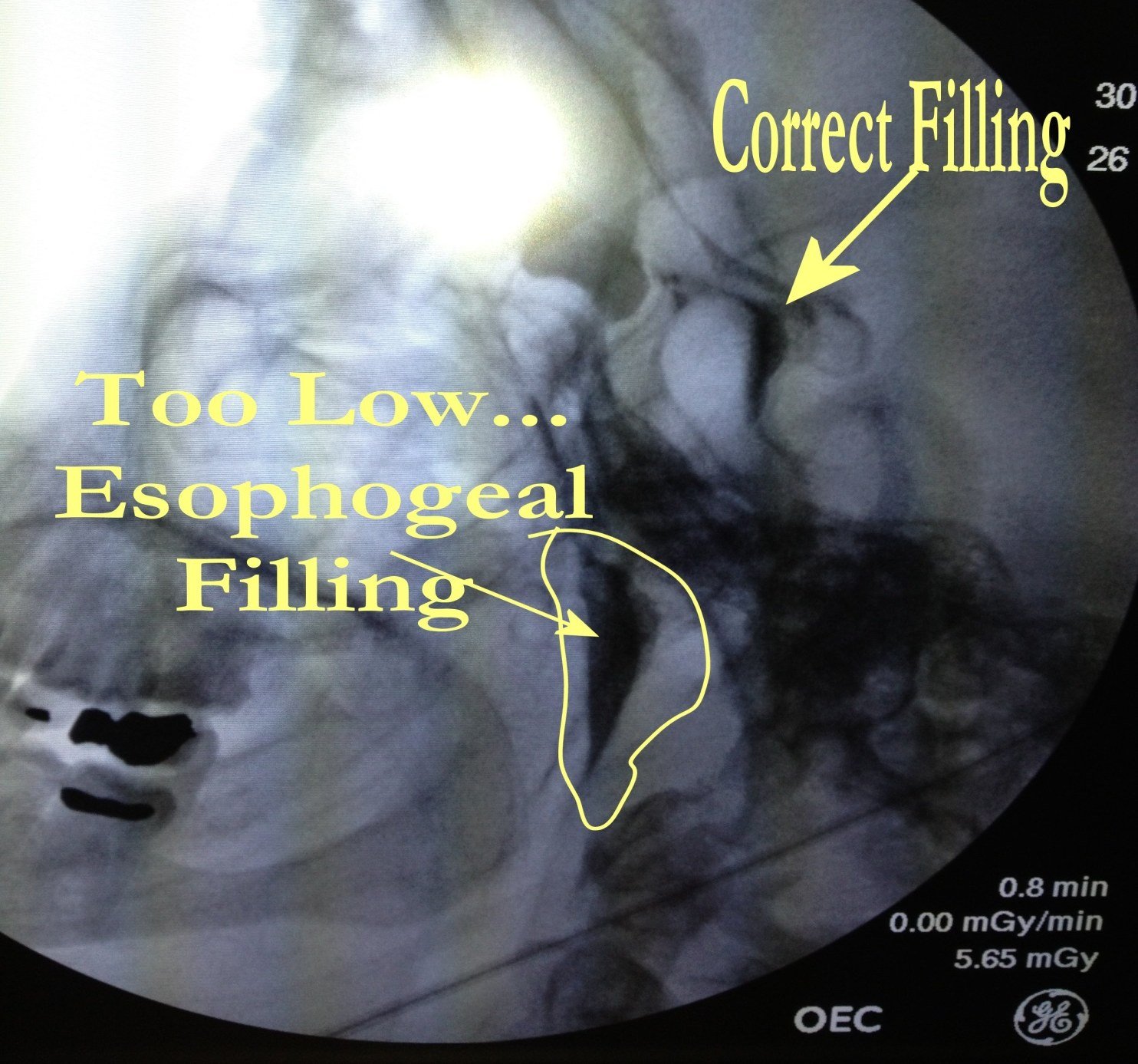
    Fluoroscopic filling study during a sphenopalatine ganglion block, labeled to contrast correct filling at the spheno-ethmoid recess with a too-low catheter position producing esophageal filling
    Why placement is checked rather than assumed: contrast at the spheno-ethmoid recess is correct placement; contrast tracking down into the esophagus means the catheter sat too low.

    Every injection at this clinic is placed under ultrasound or fluoroscopic guidance. Not as an upgrade, not on request — as the default.

    Three separate reasons

    It works more often

    Placed by surface landmarks — feeling for a bony prominence and estimating the rest — the needle goes where the anatomy is usually found. Anatomy varies between people. If the medication does not reach the target, the block fails for a reason that has nothing to do with whether the treatment is effective.

    It is safer

    Around the head and neck, the structures you are avoiding sit millimeters from the ones you are aiming at. The occipital artery runs alongside the occipital nerve. The stellate ganglion sits among the carotid artery, the internal jugular vein, the vertebral artery, the thyroid and the esophagus. The atlanto-axial joint is adjacent to the vertebral artery and the C2 nerve root, with the spinal cord millimeters away.

    A landmark technique cannot see any of them. Ultrasound shows vessels and soft tissue in real time, with Doppler to confirm which is which. Fluoroscopy shows the needle against bone from multiple angles, and contrast injected first confirms both that the medication will reach the target and that the needle has not entered a vessel.

    A negative result becomes trustworthy

    This is the one people do not think about, and it may be the most valuable. A great deal of headache diagnosis rests on diagnostic blocks — ICHD-3 accepts abolition of the headache by diagnostic blockade as evidence that a cervical structure is the cause.1

    That logic only holds if you know the block reached its target. An unguided block that fails is uninterpretable: it may have missed. A guided block that fails tells you the pain is arising somewhere else, which is real information you can act on. See do nerve blocks for headache actually work.

    Which technique, and why

    Ultrasound

    Real-time soft-tissue imaging, no radiation. Used for the stellate ganglion block, for occipital nerve blocks, and for the superficial trigeminal branches. The needle is watched moving through tissue as it advances.

    Fluoroscopy

    Live X-ray, for targets defined by bone. Used for the atlanto-axial (C1–C2) injection, for cervical facet and medial branch work, and for deeper trigeminal approaches. Contrast is injected first and watched as it spreads.

    What it means for you

    Practically: a procedure that takes a few minutes longer, and a result you can rely on either way.

    If you have had an injection elsewhere that did not help, it is worth finding out whether it was image guided. A repeat of the same block done properly is a different test, not a repeat. See ultrasound and fluoroscopic guidance.

    Common questions

    Does image guidance make the injection hurt more?

    No. Ultrasound adds a probe on the skin and nothing else. Fluoroscopy adds positioning time. Neither adds pain, and better placement often means less discomfort. See image guidance.

    Is the radiation from fluoroscopy a concern?

    Exposure for a single targeted injection is low and used only where bony landmarks require it. Where ultrasound can do the job, we use ultrasound and there is no radiation at all. See image guidance.

    How do I ask whether my previous injection was guided?

    Ask directly whether ultrasound or fluoroscopy was used, and whether contrast was injected. If neither was, a failed result does not tell you the treatment was wrong for you. See contact us.

    Are some injections safe without guidance?

    Some superficial blocks are routinely done by landmarks. But the ones we do around the neck — stellate ganglion and atlanto-axial in particular — are not among them, and we do not perform those blind. See atlanto-axial injection.

    Being seen at Headache Express. We treat migraine, cluster and other severe headaches in St. Louis, usually the same day. Please contact us before coming in so the right treatment is ready when you arrive.

    Sources

    1. Headache Classification Committee of the International Headache Society. ICHD-3, 11.2.1 Cervicogenic headache. ichd-3.org
  • When a migraine will not break: what IV therapy does

    If oral medication has failed, or you are vomiting, the problem is often not the drug — it is that the drug never got in.

    Migraine slows gastric emptying as part of the disease, not as a side effect of it. A tablet taken three hours into an attack can sit in the stomach largely unabsorbed. Vomiting removes the option entirely. Giving the same drug classes intravenously takes absorption out of the equation.

    What goes in

    The combination is chosen for the attack rather than issued as a fixed recipe, but it is generally drawn from four components:

    • An anti-nausea agent such as metoclopramide or prochlorperazine. These are not only for the nausea — the dopamine-blocking antiemetics have genuine anti-migraine activity, which is why they are a mainstay of acute treatment rather than an afterthought.
    • Fluids, where vomiting or poor intake has left you dry. Hydration alone rarely aborts a migraine, and we will not tell you it does.
    • Magnesium, which has its clearest evidence in migraine with aura and in people who are genuinely deficient.
    • An anti-inflammatory such as ketorolac, and in some cases a single dose of dexamethasone — the latter given specifically to reduce the chance of the headache returning over the next day or two.

    What does not go in

    Opioids. For migraine they are close to the worst available option: they do not address the mechanism, they worsen the nausea, and they interact badly with the antiemetics that do help. They also cross into medication overuse at a low threshold — 10 days a month — and are associated with progression from episodic to chronic headache.

    That is a clinical argument about primary headache, not a blanket position. Opioids remain appropriate in other conditions treated here, including head and neck cancer pain.

    What the visit is like

    You are in a chair, not a bed. An IV is placed, the infusion runs, and most people are here somewhere between one and two hours. Metoclopramide and prochlorperazine can cause restlessness in a minority of people; we watch for it and can treat it directly if it appears. You are not sedated and you can drive yourself home unless we tell you otherwise.

    When it is the right call

    • An attack that has not responded to your usual oral treatment
    • Vomiting that makes oral treatment pointless
    • An attack running into its second or third day
    • Cover during withdrawal from an overused acute medication, where you need something that does not feed the cycle

    That last use is underrated. Unwinding medication-overuse headache means stopping the offending drug while the withdrawal headache peaks, and having a way through that window is often what makes the difference between succeeding and giving up.

    What it is not

    It is not a preventive. It stops the attack in front of you. If you are having 15 or more headache days a month, the conversation shifts to prevention — see Botox for chronic migraine and headache prevention.

    And it is not for cluster headache. That responds to high-flow oxygen, which works in minutes.

    Common questions

    Why not just take a stronger tablet?

    Because the limiting factor is often absorption rather than potency. Gastric emptying slows during migraine, so a stronger tablet can sit unabsorbed just as easily as a weaker one. See IV migraine therapy.

    How long does it take?

    Most people are here between one and two hours, in a chair rather than a bed. You are not sedated and can usually drive yourself home. See IV migraine therapy.

    Will the headache come back the next day?

    It can. Where recurrence is a pattern, a single dose of dexamethasone during the infusion is used specifically to reduce that risk. See IV migraine therapy.

    Can I have this while withdrawing from painkillers?

    Yes, and it is one of the better uses for it, because it breaks the acute headache without adding to the overuse. See medication-overuse headache.

    Being seen at Headache Express. We treat migraine, cluster and other severe headaches in St. Louis, usually the same day. Please contact us before coming in so the right treatment is ready when you arrive.

    Sources

    1. Headache Classification Committee of the International Headache Society. ICHD-3, 8.2 Medication-overuse headache. ichd-3.org

    A note on coverage, and on timing. Same-day treatment and prior authorization do not run on the same clock. Many insurers take days to weeks to decide, and some acute headache treatments are not covered at all. Your headache will not wait for that process.

    We will verify your benefits and, where a treatment needs prior authorization, we will attempt to obtain it. An authorization confirms that a service meets criteria for review — it is not a guarantee of payment, and no clinic can make that promise on your insurer’s behalf. Where something is unlikely to be covered, or cannot be certified in time to treat you today, we will tell you before we treat rather than after, so the decision is yours. Payment is due at the time of service.

  • Do nerve blocks for headache actually work?

    For cluster headache the evidence for a greater occipital nerve block is reasonable. For other headache types it is weaker, and the block’s main value is often diagnostic rather than therapeutic. Both of those are worth saying plainly.

    Cluster headache: the strongest case

    A systematic review and meta-analysis of greater occipital nerve block for cluster headache found a pooled proportion of pain-free patients at one month of 50% (95% CI 24–76), and across the two included randomized controlled trials a relative risk of pain freedom in active versus control groups of 4.86 (95% CI 1.35–17.55).1

    Those confidence intervals are wide, which is honest: this is a small evidence base. But the direction is consistent and the effect is large. The block is typically used as a transitional treatment — interrupting a bout while a preventive medication is brought up to an effective dose — rather than as a standalone.

    A 2024 double-blind randomized trial of methylprednisolone and lignocaine versus placebo as transitional treatment in episodic cluster headache supported the same role.2 See occipital nerve block.

    Occipital neuralgia: the block is the test

    Here the logic is different and cleaner. If anesthetizing a specific nerve abolishes pain in that nerve’s territory, that nerve is implicated. If it does not, the pain is coming from somewhere else.

    That makes a block useful whichever way it turns out, which is unusual in medicine. A block that fails is not a failed treatment — it is a redirected diagnosis. See occipital neuralgia or migraine.

    Cervicogenic headache: diagnostic by definition

    ICHD-3 explicitly accepts abolition of the headache by diagnostic blockade of a cervical structure or its nerve supply as evidence of causation.3 The block is written into the diagnostic criteria. See is your headache coming from your neck.

    Migraine: more mixed

    Occipital nerve blocks are used in migraine and many people report benefit, but the trial evidence is less consistent than in cluster. The clearest indication is where there is a cervical or occipital contribution — scalp tenderness, neck-triggered attacks, pain running from the base of the skull — rather than in migraine generally.

    We will tell you when the case is thinner. See migraine treatment.

    The condition that makes any of this interpretable

    All of the above assumes the injection reached the intended target. Placed by surface landmarks alone, it goes where the anatomy usually is — and anatomy varies. Around the head and neck the structures you are avoiding sit millimeters from the ones you are aiming at.

    This is why every injection here is placed under ultrasound or fluoroscopic guidance. It is not a refinement. It is what makes a negative result mean something. A failed landmark block tells you nothing; a failed guided block tells you the pain is coming from elsewhere.

    It also means there is no fixed series of three. The interval is set by how long the previous block held and by what is happening clinically, not by a schedule.

    Common questions

    How long does a nerve block last?

    The anesthetic wears off in hours, but relief frequently outlasts it by weeks — longer than the pharmacology alone explains. Duration varies widely between people. See occipital nerve block.

    Is it just a steroid injection?

    Not necessarily. The injectate is local anesthetic, sometimes with a corticosteroid depending on the indication. For a purely diagnostic block, anesthetic alone is often the point. See image guidance.

    What if the block doesn’t help?

    Then, provided it was image-guided, that is useful information rather than a wasted appointment: the pain is arising somewhere other than the structure we blocked, and the diagnosis moves. See image guidance.

    Do I need sedation?

    No. Occipital and superficial trigeminal blocks take seconds, and an SPG block involves no needle at all. You drive yourself home.

    How many can I have?

    There is no fixed course. We time the next one by how long the last one held and by clinical need — see occipital nerve block.

    Being seen at Headache Express. We treat migraine, cluster and other severe headaches in St. Louis, usually the same day. Please contact us before coming in so the right treatment is ready when you arrive.

    Sources

    1. Zhang H, et al. Efficacy and safety of greater occipital nerve block for the treatment of cluster headache: a systematic review and meta-analysis. 2020. PMID 32781922. pubmed.ncbi.nlm.nih.gov
    2. Chowdhury D, Kordcal SR, Nagane R, Duggal A. ANODYNE study: a double-blind randomized trial of greater occipital nerve block of methylprednisolone and lignocaine versus placebo as a transitional preventive treatment for episodic cluster headache. Cephalalgia, 2024. journals.sagepub.com
    3. Headache Classification Committee of the International Headache Society. ICHD-3, 11.2.1 Cervicogenic headache. ichd-3.org
  • Botox for chronic migraine: who it is for and what to expect

    Botox [onabotulinumtoxinA] is a preventive for chronic migraine, defined as headache on 15 or more days a month. If you have migraine four times a month, this is not your treatment and the trials say so.

    That distinction is the whole article. It is also the thing most often glossed over when the treatment is offered.

    The protocol is fixed, and that is deliberate

    The evidence rests on a specific injection paradigm from the PREEMPT clinical program: 155 units delivered as 31 fixed-site, fixed-dose injections across seven head and neck muscle areas, repeated every 12 weeks.1 An additional 40 units may be added at the clinician’s discretion using a follow-the-pain approach, to a maximum of 195 units.1

    PREEMPT 1 and 2 together enrolled 1,384 people with chronic migraine in a 24-week double-blind, placebo-controlled phase followed by a 32-week open-label phase.1,2

    It is worth knowing the protocol is standardized rather than improvised, because it is what the evidence describes. Cosmetic Botox is a different treatment: different sites, different dose, different purpose. A cosmetic injection pattern will not treat migraine.

    Why episodic migraine is excluded

    This is not a technicality or an insurance obstacle. Trials in people with fewer than 15 headache days a month did not demonstrate benefit, which is why the indication is written the way it is. If you are below that threshold, the honest answer is that Botox is unlikely to help you and there are better options.

    Counting matters, then. Not an estimate — an actual calendar, for a month, marking every day you had any headache at all. Most people are surprised in one direction or the other. See headache prevention.

    What the appointment is like

    The needles are very fine and the injections are shallow, into muscle across the forehead, temples, back of the head, neck and shoulders. The whole appointment takes around fifteen minutes. There is no sedation and you drive yourself home.

    Common after-effects are neck stiffness and soreness at the injection sites for a few days. Temporary eyelid or brow droop occurs in a small minority and resolves. It is avoided in pregnancy and in some neuromuscular conditions.

    Honest expectations

    The effect builds. Most people who respond do not respond fully to the first round — benefit typically accumulates over two to three cycles, which means roughly six months before you and I can say whether this works for you. Planning for one round and a verdict is planning to be disappointed.

    It reduces headache days rather than abolishing them. A meaningful response is a substantial cut in frequency, not a cure. And it is a preventive, not a rescue: it will not stop the attack you are having today. For that, see IV migraine therapy.

    The thing to rule out first

    A great many people who meet the 15-day threshold are in a medication-overuse cycle, where daily acute treatment is sustaining the daily headache. Treating that first sometimes drops the frequency below the chronic threshold on its own.

    Starting an expensive preventive to fight a problem the medicine cabinet is creating is a poor use of both. We ask about this before we inject.

    Common questions

    How many headache days a month do I need?

    Fifteen or more, of which at least eight have migraine features, sustained for more than three months. Bring a month of counted days rather than an estimate — see Botox for chronic migraine.

    How long before I know if it works?

    Plan on two to three cycles, roughly six months. Benefit accumulates rather than arriving all at once, and judging it on one round is the most common mistake. See Botox for chronic migraine.

    Is this the same as cosmetic Botox?

    No. The sites, the dose and the purpose are different. A cosmetic pattern does not treat migraine, and the migraine protocol is not a cosmetic treatment. See Botox for chronic migraine.

    Can I have Botox and nerve blocks?

    They are not mutually exclusive and serve different roles — one preventive, one targeted and often diagnostic. Which combination fits depends on your pattern; see occipital nerve block.

    What if I have fewer than 15 headache days?

    Then Botox is not indicated and we will say so. The conversation moves to acute treatment and to prevention that fits episodic migraine — see migraine treatment.

    Being seen at Headache Express. We treat migraine, cluster and other severe headaches in St. Louis, usually the same day. Please contact us before coming in so the right treatment is ready when you arrive.

    Sources

    1. Dodick DW, Turkel CC, DeGryse RE, et al. OnabotulinumtoxinA for treatment of chronic migraine: pooled results from the double-blind, randomized, placebo-controlled phases of the PREEMPT clinical program. Headache. 2010;50(6):921–936. PMID 20487038. pubmed.ncbi.nlm.nih.gov
    2. Aurora SK, Dodick DW, Turkel CC, et al. OnabotulinumtoxinA for treatment of chronic migraine: results from the double-blind, randomized, placebo-controlled phase of the PREEMPT 1 trial. Cephalalgia. 2010;30(7):793–803. journals.sagepub.com
  • Why oxygen fails for some people with cluster headache

    Before you accept that oxygen does not work for you, check four things: the mask, the flow rate, how early you started, and where the cylinder was. Most failures are one of those, not biology.

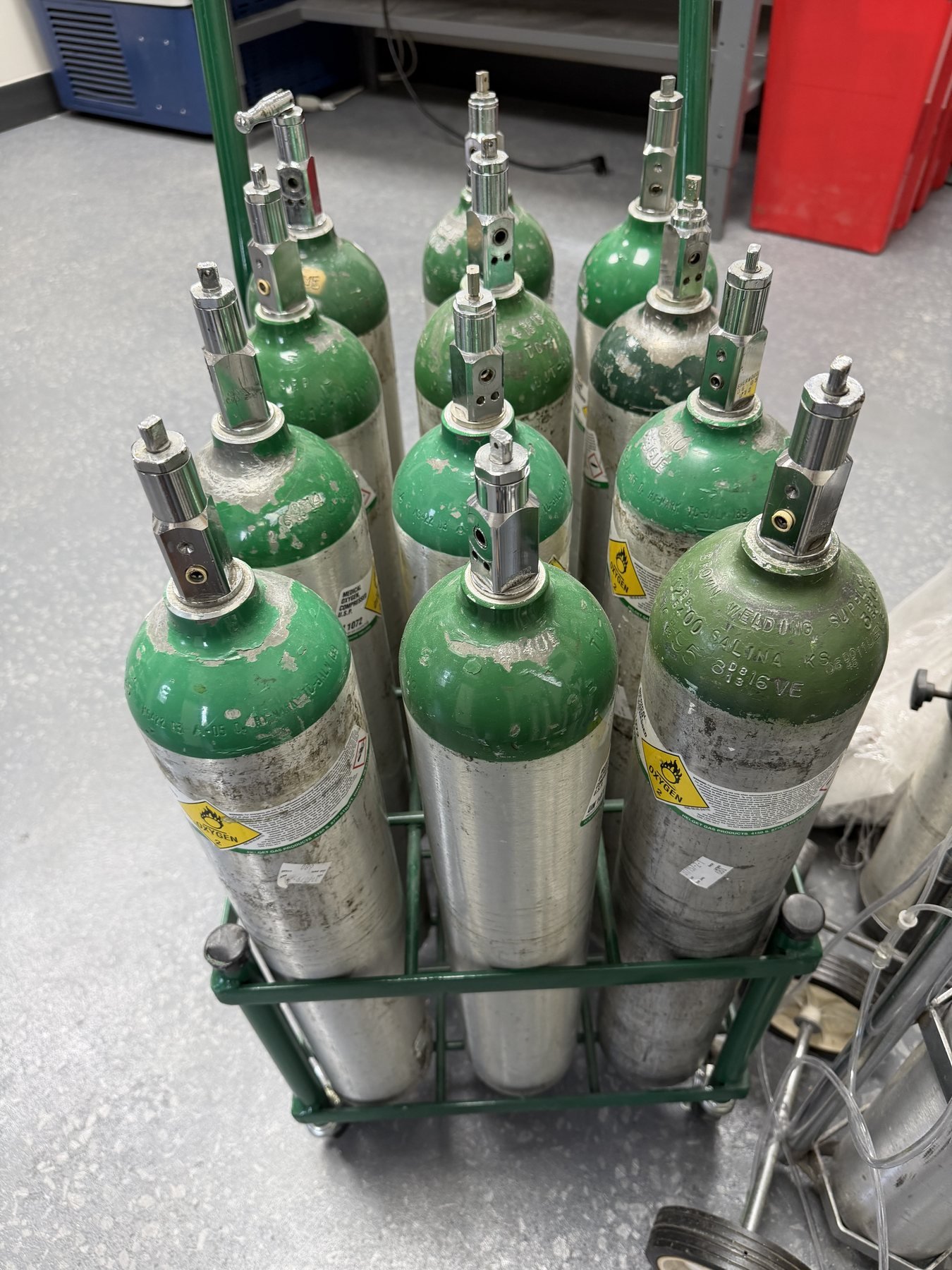
    Rack of medical oxygen cylinders with regulators at the Headache Express clinic in St. Louis
    Medical oxygen at the clinic. A cylinder is only half of it; the delivery is the part that usually goes wrong.

    This matters because oxygen is the abortive with the best evidence in cluster headache and essentially no side effects. Writing it off wrongly costs you the best tool available.

    1. The mask

    The trial that established the effect used a face mask delivering 100% oxygen.1 A nasal cannula cannot deliver this treatment at any flow rate — you breathe room air around it. A simple face mask without a reservoir bag entrains room air too, diluting the oxygen below what is needed.

    What you need is a non-rebreather mask with a reservoir bag, fitted so it seals reasonably against the face. If the bag collapses on inspiration, the flow is too low.

    2. The flow rate

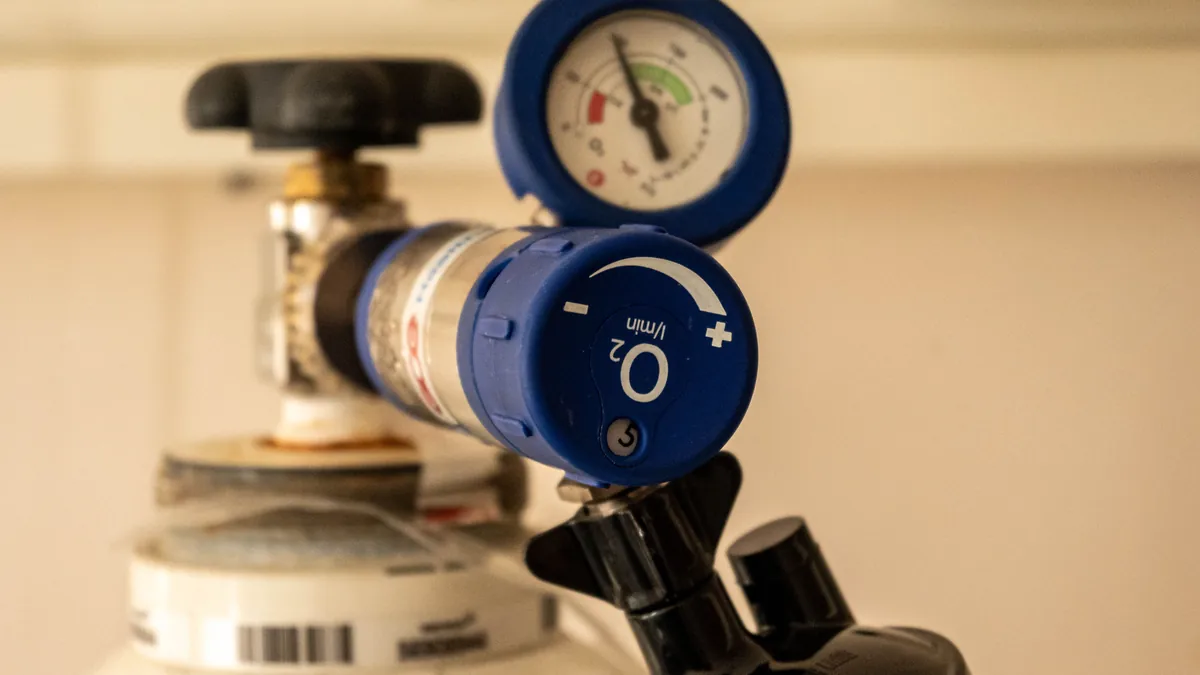
    Twelve liters per minute in the trial. If you were sent home on two, three or four liters — the flow rates typical for chronic lung disease — you were not given this treatment. That mismatch happens because oxygen prescriptions default to the respiratory use case, which is a completely different intervention with a completely different goal.

    3. When you started

    Oxygen is an abortive and works best from the first sign of an attack. Cluster peaks within minutes. Starting twenty minutes in, once the pain is established, is a materially different test from starting at onset.

    4. Where the cylinder was

    An abortive you cannot reach is not a treatment. Attacks that wake people at 3am are the classic case: the oxygen is in the front room, or at the clinic, and by the time it is running the attack has done most of its work. Home setup is part of the treatment, not an optional extra.

    If all four were right

    Then two questions remain. The first is whether the diagnosis is correct — oxygen is highly specific to cluster and related trigeminal autonomic headaches, and it does not treat migraine. A genuine non-response to properly delivered oxygen is a reason to revisit whether this is cluster at all. Read migraine or cluster headache against your own attack pattern.

    The second is that even in the trial, oxygen did not work for everyone: 78% reached the endpoint at 15 minutes, which means roughly one in five attacks did not respond.1 Some people genuinely are non-responders, and for them the plan moves to other abortives and to bout-shortening options such as a greater occipital nerve block or an SPG block.

    What we do about it

    We check the equipment before we check anything else, and we arrange a setup you can actually reach during an attack. See oxygen therapy and cluster headache treatment.

    Dr. Gurpreet Singh Padda, MD, MBA, MHP has lived with chronic cluster headache since the age of 17, which is why the guidance here is unusually specific about flow rates and masks. The detail is the difference between a treatment that works in fifteen minutes and one more person concluding oxygen is useless.

    Common questions

    How do I know if my mask is the right one?

    A non-rebreather has a reservoir bag hanging below it and one-way valves. If there is no bag, it is not a non-rebreather. If the bag deflates fully when you breathe in, the flow rate is too low. See oxygen therapy.

    My oxygen was prescribed for my lungs. Can I use the same setup?

    Usually not as-is. Respiratory oxygen is typically delivered by cannula at low flow, which cannot abort a cluster attack. The prescription for cluster is a different flow rate and a different mask — contact us to sort it out.

    How long should I breathe it for?

    The trial used 15 minutes. If the attack breaks sooner you can stop; if there is no effect at all by 15 to 20 minutes with correct delivery, that is a genuine non-response worth reporting. See oxygen therapy.

    Can I use it as often as I need?

    There is no ceiling in the way there is with drug abortives, and no interactions to manage — which is one of its main advantages. Frequency of attacks is itself information about bout control, so tell us the count. See cluster headache treatment.

    Being seen at Headache Express. We treat migraine, cluster and other severe headaches in St. Louis, usually the same day. Please contact us before coming in so the right treatment is ready when you arrive.

    Sources

    1. Cohen AS, Burns B, Goadsby PJ. High-flow oxygen for treatment of cluster headache: a randomized trial. JAMA. 2009;302(22):2451–2457. jamanetwork.com
  • High-flow oxygen for cluster headache: what the evidence shows

    High-flow oxygen is one of the few treatments in headache medicine that is both highly effective and essentially free of side effects — for cluster headache specifically. It does nothing for migraine.

    The trial

    Cohen, Burns and Goadsby randomized patients with cluster headache to inhaled 100% oxygen at 12 liters per minute via a face mask for 15 minutes, or to high-flow air, treating four attacks each in a crossover design.1

    The primary outcome was being pain-free, or having adequate relief, at 15 minutes after starting treatment. The result:

    • Oxygen: 78% (95% CI 71–85), across 150 attacks
    • Air: 20% (95% CI 14–26), across 148 attacks

    Seventy-six patients completed the study — 57 with episodic and 19 with chronic cluster headache — of 109 randomized.1 The effect size is unusually large for a headache trial, and it is why oxygen sits at the top of cluster treatment guidance.

    Worth naming the population precisely: these were people with a confirmed cluster headache diagnosis. The result does not transfer to headache in general, and it does not transfer to migraine.

    Why the delivery detail is the whole treatment

    The trial used 100% oxygen at 12 L/min through a face mask. Reproducing the result requires reproducing that.

    A nasal cannula at two or three liters a minute does not do it. Neither does a simple mask at a low flow rate, because entrained room air dilutes the oxygen. You need a non-rebreather mask with a reservoir bag, and a flow rate high enough to keep that bag inflated through each breath.

    This is the single most common reason someone says oxygen did not work for them. In our experience the treatment was rarely tried properly — it was tried at a flow rate that could not deliver the intervention. Before concluding that you are an oxygen non-responder, check what equipment you were actually given.

    Timing

    Oxygen is an abortive. It works best started at the first sign of an attack, which is a problem if the cylinder is somewhere you are not. An abortive that requires a drive is close to useless for a condition that peaks in minutes and may be over in under an hour.

    Part of what we do is get a home setup in place so you can treat within the first minutes. See oxygen therapy.

    What it does not do

    It does not prevent attacks. It aborts the one you are having, and you can use it as often as attacks occur — there is no ceiling and no interaction to manage, which is a genuine advantage over every drug option. Preventing the bout is a separate conversation, and can involve a greater occipital nerve block as a bridge while a preventive medication is brought up to dose.

    And it is not a migraine treatment. Hyperbaric oxygen — a different intervention entirely, in a pressurized chamber — has been studied in acute migraine with low-quality evidence and is not recommended as routine treatment. We offer both and we do not present them as equivalent. See oxygen therapy for the distinction.

    Common questions

    What flow rate should I be using?

    The trial that established the effect used 100% oxygen at 12 L/min through a face mask for 15 minutes. The key requirement is a non-rebreather with the reservoir bag staying inflated. See oxygen therapy.

    Is high-flow oxygen dangerous?

    For short abortive use in cluster headache it is remarkably well tolerated, with no systemic side effects and no interactions. Oxygen is an oxidiser, so the practical cautions are about fire safety and about people with certain chronic lung conditions. Discuss your history with us — contact.

    Will oxygen help my migraine?

    No. High-flow normobaric oxygen is a cluster headache treatment. If migraine is your diagnosis, see migraine treatment instead.

    I tried oxygen and it didn’t work. What now?

    First establish what you were given — flow rate and mask type — because a low-flow cannula is not the same intervention. If it was delivered properly and still failed, the diagnosis is worth revisiting. See cluster headache treatment.

    Being seen at Headache Express. We treat migraine, cluster and other severe headaches in St. Louis, usually the same day. Please contact us before coming in so the right treatment is ready when you arrive.

    Sources

    1. Cohen AS, Burns B, Goadsby PJ. High-flow oxygen for treatment of cluster headache: a randomized trial. JAMA. 2009;302(22):2451–2457. jamanetwork.com