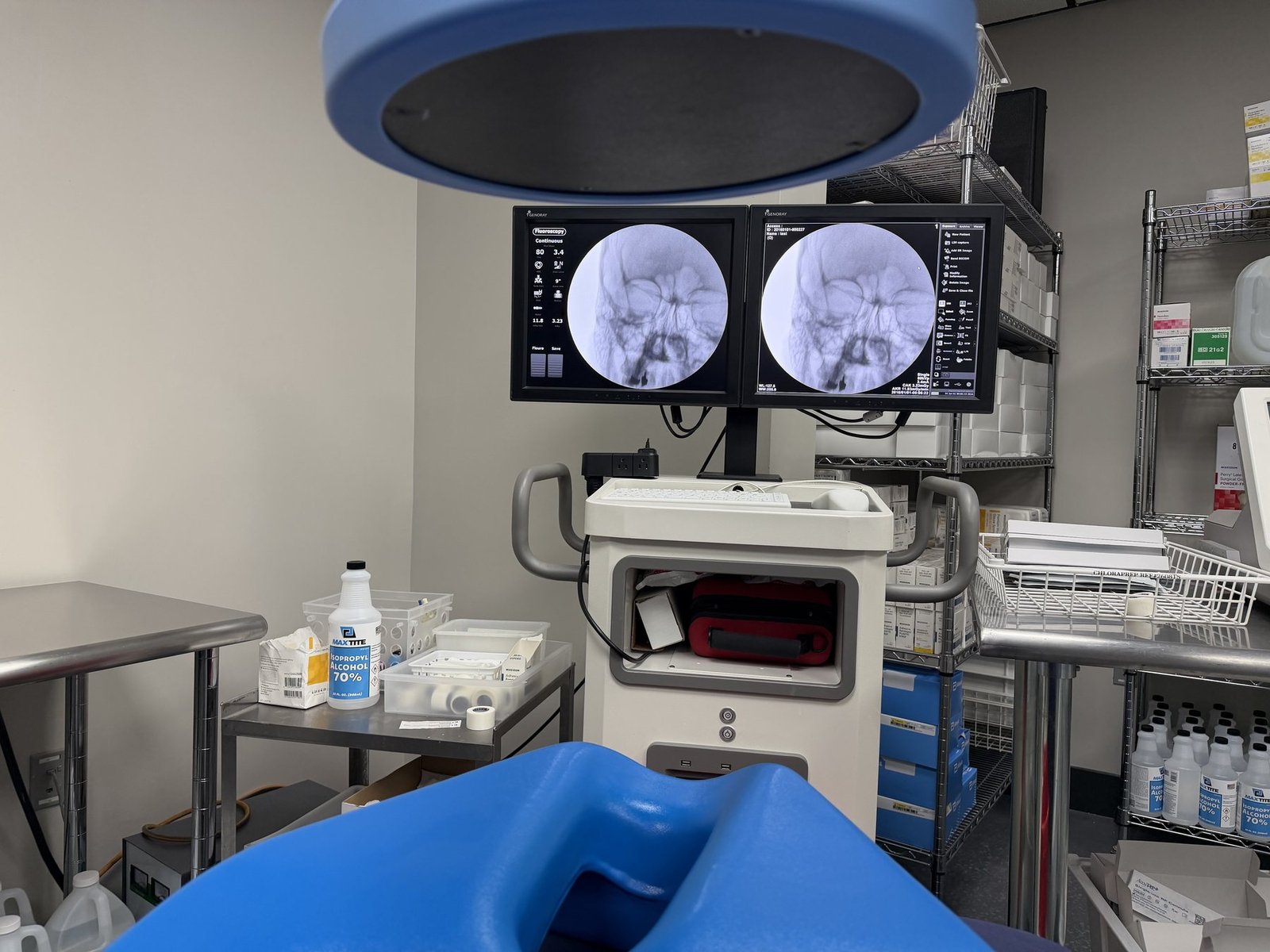
Every headache injection here is placed under ultrasound or fluoroscopic guidance. Not as an upgrade, and not on request — as the default.
Why does image guidance matter for a nerve block?
A nerve block is only as good as where the needle actually ends up. Some blocks are placed by surface landmarks alone — feeling for a bony bump and estimating the rest. In that case, the needle goes where the anatomy is usually found. Anatomy varies between people. Around the head and neck, the structures you are trying to avoid are millimeters from the ones you are aiming at.
Image guidance replaces the estimate with a picture. It matters in three separate ways. The medication reaches the intended target, so the block is more likely to work. The vessels and nerves you are avoiding are visible, so it is safer. And when a guided block does not relieve the pain, that result is trustworthy. A failed landmark block tells you nothing — it may have missed. A failed guided block tells you the pain is coming from somewhere else. That is diagnostic information you can act on.
When is an ultrasound-guided injection used?
Real-time imaging of soft tissue, with no radiation. It shows nerves, muscle planes and — critically — blood vessels. Live Doppler (a view of blood flow) confirms which is which. The needle is watched moving through the tissue as it advances.
This is the technique for the stellate ganglion block. There, the target sits among the carotid, the jugular, the vertebral artery, the thyroid and the esophagus. It is also the technique for occipital nerve blocks, where the occipital artery runs alongside the nerve. And it is used for the superficial trigeminal branches.
What is a fluoroscopy-guided injection?
Live X-ray. Some targets are defined by bone rather than soft tissue. For those, fluoroscopy shows the needle against the vertebral anatomy from multiple angles. Contrast is injected first and watched as it spreads. It confirms the medication will reach the target. It also shows at once if the needle has entered a blood vessel — which is the complication that matters most in the neck.
This is the technique for the atlanto-axial (C1–C2) injection, for cervical facet and medial branch work, and for deeper trigeminal approaches.
What this means for you
Practically, this means a procedure that takes a few minutes longer, and a result you can rely on either way. Maybe you have had an injection elsewhere that did not help. If so, it is worth finding out whether it was image guided. A repeat of the same block done properly is a different test.
Frequently asked questions
Is ultrasound or fluoroscopy better for a nerve block?
It depends on what the needle is aiming at. Ultrasound shows nerves, muscle planes and blood vessels with no radiation. So it guides stellate ganglion, occipital and superficial trigeminal blocks. Fluoroscopy is live X-ray. It is used where the target is defined by bone: the atlanto-axial (C1–C2) injection, cervical facet and medial branch work, and deeper trigeminal approaches.
Why is contrast dye used in a fluoroscopy-guided injection?
Before the medication goes in, contrast is injected and watched on live X-ray as it spreads. It confirms that the medication will reach the target. It also shows at once if the needle has entered a blood vessel. That is the complication that matters most in the neck. Only then is the medication given.
What does it mean if an image-guided block does not help?
It means something. In a guided block, the needle position was seen and confirmed. So a block that fails to relieve the pain tells you the pain is coming from somewhere else. That is diagnostic information you can act on. A landmark block that fails tells you nothing, because it may simply have missed the target.
What are the downsides of image guidance?
Practically, the procedure takes a few minutes longer. Ultrasound uses no radiation. Fluoroscopy is live X-ray. It is used where the target is defined by bone and the needle has to be seen from more than one angle. In exchange, the vessels and nerves being avoided are visible. And you get a result you can rely on either way.
Should I repeat an injection that did not work elsewhere?
First find out whether it was image guided. A block placed by surface landmarks alone goes where the anatomy is usually found. And anatomy varies between people. A repeat of the same block done under ultrasound or fluoroscopy is a different test. Its result, good or bad, is one you can trust.
Sources
- Kissoon NR, O'Brien TG, Bendel MA, et al. Comparative Effectiveness of Landmark-guided Greater Occipital Nerve (GON) Block at the Superior Nuchal Line Versus Ultrasound-guided GON Block at the Level of C2: A Randomized Clinical Trial (RCT). The Clinical journal of pain, 2022. PMID 35132029. pubmed.ncbi.nlm.nih.gov
- Barad M, Ailani J, Hakim SM, et al. Percutaneous Interventional Strategies for Migraine Prevention: A Systematic Review and Practice Guideline. Pain medicine (Malden, Mass.), 2022. PMID 34382092. pubmed.ncbi.nlm.nih.gov
Booking online shows our scheduled openings; call or text for hours that are not listed. Please contact us before coming in rather than arriving unannounced — we need to know what is happening to have the right treatment ready.
A note on coverage, and on timing. Same-day treatment and prior authorization do not run on the same clock. Many insurers take days to weeks to decide, and some acute headache treatments are not covered at all. Your headache will not wait for that process.
We will verify your benefits and, where a treatment needs prior authorization, we will attempt to obtain it. An authorization confirms that a service meets criteria for review — it is not a guarantee of payment, and no clinic can make that promise on your insurer’s behalf. Where something is unlikely to be covered, or cannot be certified in time to treat you today, we will tell you before we treat rather than after, so the decision is yours. Payment is due at the time of service.