
Four things separate migraine from cluster headache: which side, how long, what you do during the attack, and whether your eye and nose react on the painful side. You can check all four against your own history before you see anyone.
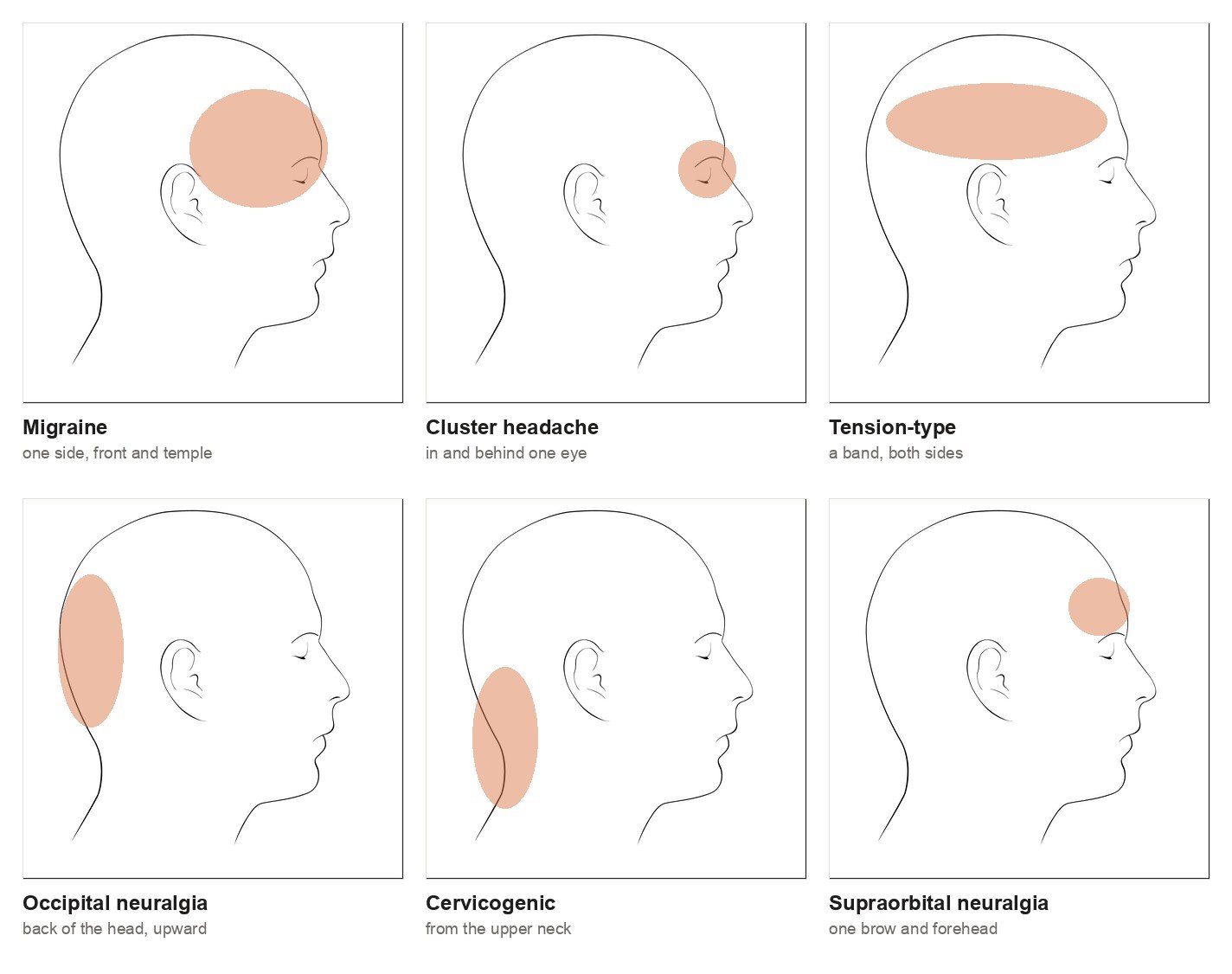
This matters more than most diagnostic questions, because the treatments barely overlap. High-flow oxygen aborts (stops) a cluster attack. It does nothing for migraine. Getting the label wrong costs years — a 2025 systematic review and meta-analysis of eleven studies put the average delay to a cluster headache diagnosis at 10.4 years.1
The four discriminators
1. Which side
Cluster pain is strictly one-sided. It sits in or behind one eye or over one temple. It stays on that side within a bout. Migraine is often one-sided but does not have to be — a bilateral (both-sided) migraine is still a migraine. Being one-sided is a rule for cluster and only a tendency for migraine.
2. How long
This is the cleanest way to tell them apart. The International Classification of Headache Disorders, 3rd edition, sets the timing. An untreated cluster attack lasts 15 to 180 minutes. It reaches full intensity within minutes.2 An untreated migraine attack lasts 4 to 72 hours and builds more slowly.3 If your attacks are reliably over inside three hours, migraine becomes unlikely.
Cluster also has a frequency pattern migraine does not. During an active bout, it runs from one attack every other day up to eight per day.2 It often strikes at the same hour and wakes people from sleep.
3. What you do during the attack
Migraine drives people to lie still in a dark, quiet room, because movement makes it worse. Cluster does the opposite. Restlessness is part of the diagnostic criteria. People pace, rock, or press a fist into the eye socket.2 Clinicians ask where it hurts far more often than they ask what you do while it hurts. The second question is often more useful.
4. Does your eye and nose react?
Cluster attacks come with cranial autonomic features (automatic body reactions in the face) on the painful side. These include a watering or reddened eye, a drooping or swollen eyelid, a constricted (small) pupil, a blocked or running nostril, facial sweating.2 These are not side details — they are the reason cluster is so often mistaken for sinus disease.
Why cluster gets called sinusitis
Picture a one-sided headache with a blocked nose, a running nostril and a red watering eye. It looks exactly like an infection to almost everyone. That includes clinicians who do not see cluster often. People are treated with repeated antibiotic courses through bout after bout.
Two features break the tie. The pain is always the same side, and it keeps time — the same hour, night after night. Sinus infections do not behave that way. Maybe you have had several courses of antibiotics for “sinus headaches” that are always left-sided or always right-sided and always start in the early hours. If so, bring that history in.
A screening question set that has been validated
Researchers at Houston Methodist built a three-item screen from a larger questionnaire. It is called the Erwin Test for Cluster Headache. Their validation study included 224 people with headache disorders — 64 of whom had cluster headache. The three items together had a sensitivity of 84% (95% CI 73–92) and a specificity of 89% (95% CI 84–94).4 The items cover pain intensity, attack duration and autonomic features: the same three things above.
A screening tool is not a diagnosis. It is a reason to be taken seriously by the next clinician you see.
The treatments are not interchangeable
For cluster, high-flow normobaric oxygen is a first-line abortive with strong randomized evidence. It is not a migraine treatment. A greater occipital nerve block can interrupt a bout. An SPG block targets the autonomic relay (the hub) behind the tearing and congestion.
For migraine, the tools are different. Intravenous therapy is for an attack that has not broken. Botox is a preventive if you are at 15 or more headache days a month.
Dr. Gurpreet Singh Padda, MD, MBA, MHP has lived with chronic cluster headache since the age of 17. You will not have to persuade anyone here that a headache can be this bad.
Common questions
Can I have both migraine and cluster headache?
Yes, and it is not rare. Having one does not exclude the other. A person can have separate attack types with different treatment plans. Track them separately in a diary — see migraine treatment and cluster headache treatment.
Does a normal MRI rule out cluster headache?
No. Cluster headache is a clinical diagnosis made from the attack pattern, not from imaging. Imaging is used to rule out other causes. A normal scan is the expected finding. See when a headache actually needs a scan.
If oxygen helps, does that confirm cluster?
It is supportive, not proof. High-flow oxygen stopping attacks fits cluster well, and it does not treat migraine — but the flow rate and mask have to be right, or the test is meaningless. See oxygen therapy.
My headache is one-sided but lasts all day. Is that cluster?
Unlikely, on duration alone. Untreated cluster attacks run 15 to 180 minutes. An all-day one-sided headache fits migraine, cervicogenic headache or occipital neuralgia better.
What should I bring to the appointment?
Bring a month of attack times, how long each lasted, which side, and every medication you took, including over-the-counter. How often you are treating is one of the most useful facts you can give us — see contact.
When it is an emergency
None of the above applies to certain headaches. That means a headache that reaches maximum intensity within seconds, a headache with fever and a stiff neck, any weakness, numbness, trouble speaking, vision loss or confusion, or a headache after a head injury. Those need an emergency department. Headache Express is an outpatient clinic, not an emergency room — call 911.
Telling migraine from cluster headache decides which treatment works, because high-flow oxygen helps a cluster attack far more than a migraine. Each has its own plan here: cluster headache treatment and migraine treatment in St. Louis.
Sources
- Peng K-P, et al. Cluster headache diagnostic delay and its predictors: a systematic review with a meta-analysis. The Journal of Headache and Pain, 2025. link.springer.com
- Headache Classification Committee of the International Headache Society. ICHD-3, 3.1 Cluster headache. ichd-3.org
- Headache Classification Committee of the International Headache Society. ICHD-3, 1. Migraine. ichd-3.org
- Parakramaweera R, Evans RW, Schor LI, et al. A brief diagnostic screen for cluster headache: creation and initial validation of the Erwin Test for Cluster Headache. Cephalalgia, 2021. PMID 34148408. pubmed.ncbi.nlm.nih.gov