Category: Headache types and diagnosis

Telling one headache apart from another. Migraine, cluster, tension-type, cervicogenic and occipital neuralgia overlap more than most people are told, and the label changes the treatment. Includes the warning signs that mean a headache needs assessing urgently.

  • When a headache actually needs a scan

    If nobody has scanned your head, that is usually the correct decision rather than a corner being cut. It is also the single most common thing people arrive here suspicious about, so it is worth explaining properly.

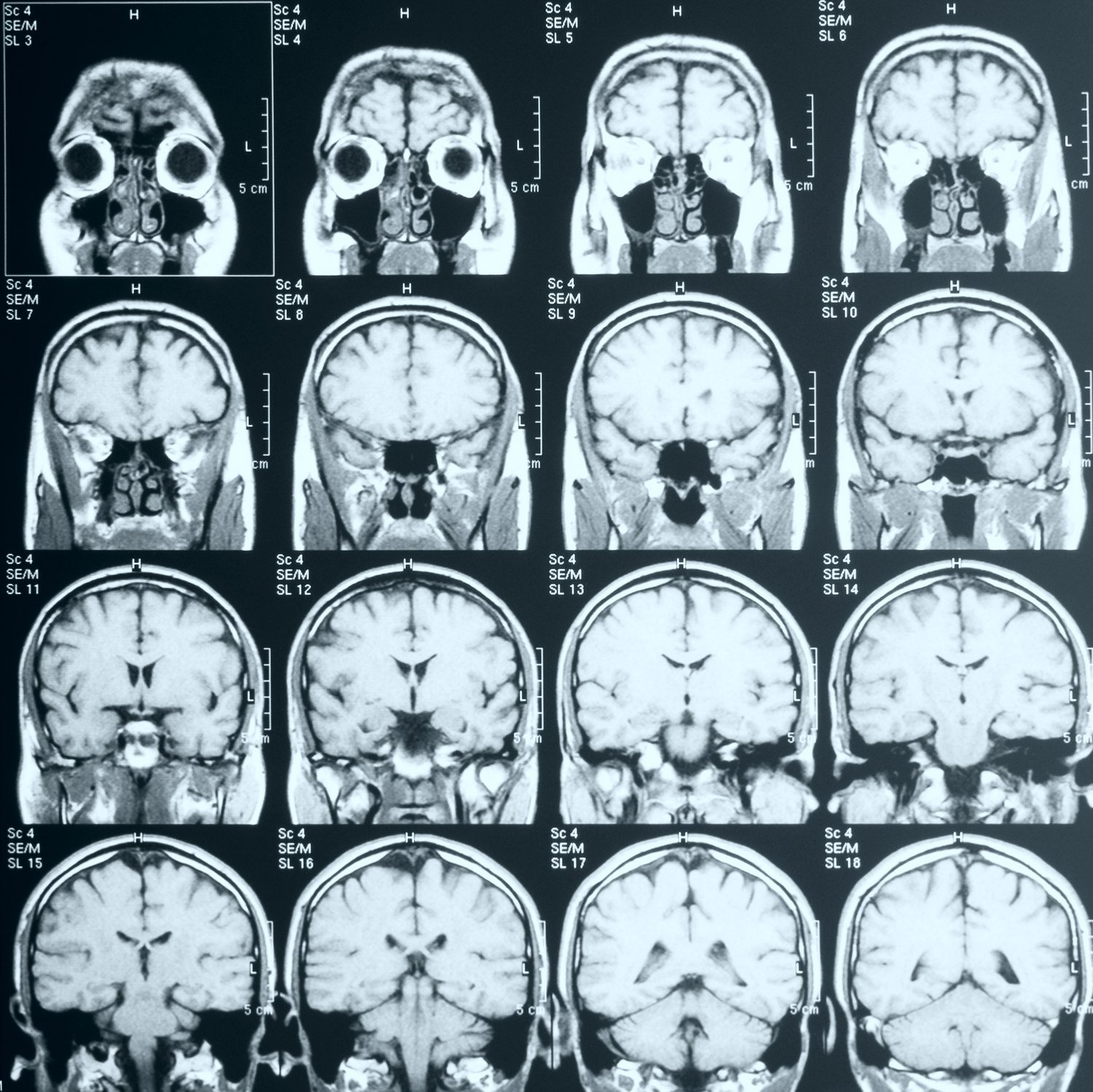
    A coronal MRI series of the head, sixteen slices from the front of the orbits back through the cerebellum, of the kind ordered when a headache has a feature that warrants imaging
    A coronal MRI series of the head. The question is not whether a scan is available — it is whether anything about your headache makes it likely to show something that changes what we do.

    What the guidelines actually say

    The American Headache Society’s Choosing Wisely list opens with it: do not perform neuroimaging in patients with stable headaches that meet criteria for migraine.1 The American College of Radiology reaches the same conclusion from the imaging side — most patients with uncomplicated, non-traumatic, primary headache do not require imaging.2

    This is not a cost-cutting position dressed up as evidence. In a headache that fits a primary pattern with a normal neurological examination, a scan is overwhelmingly likely to be normal, and a normal scan does not change the treatment. What changes the treatment is the diagnosis, and the diagnosis is made from the history and the examination.

    When imaging IS warranted

    The features that shift the balance are specific and worth knowing. The ACR lists headaches that are:2,3

    • Associated with head trauma.
    • New, worse, or abrupt in onset — including thunderclap headache, which reaches maximum intensity within seconds.
    • Persistent and positional — clearly worse lying down, or clearly worse standing up.
    • Radiating to the neck.
    • Accompanied by a neurological deficit on examination, or by optic disc swelling.
    • New in someone aged 50 or over, particularly temporal headache.
    • Occurring in specific contexts — pregnancy, cancer, an immunocompromised state, or a systemic illness including a clotting disorder.2,3

    The three most people do not expect

    Headaches brought on by coughing, by exertion, or by sexual activity usually require MRI of the brain with and without contrast to exclude underlying pathology before a primary headache syndrome is diagnosed.2

    That is worth reading twice, because these are exactly the headaches people are least likely to mention. A headache that only happens when you cough, or when you lift, or during sex, feels embarrassing or trivial rather than alarming. It is the reverse. Tell us about it.

    MRI or CT

    Where imaging is indicated and it is not an emergency, MRI is the right test. The Choosing Wisely list is explicit: do not perform CT for headache when MRI is available, except in emergency settings.1 CT is fast and it is very good at finding acute bleeding, which is why it is the emergency test. It involves ionizing radiation and it is far less sensitive for most of what else might be found.

    What a normal scan does and does not tell you

    A normal scan excludes a structural lesion. It does not exclude migraine, cluster headache, occipital neuralgia, cervicogenic headache or medication-overuse headache — none of which are visible on imaging at all. Every one of those is diagnosed clinically.

    So a normal MRI is not a dead end and it is not a statement that nothing is wrong. It is the expected result, and it moves the question to where it belonged: which primary headache disorder is this, and what drives it. See migraine or tension-type headache and occipital neuralgia or migraine.

    The case against scanning everyone

    Yield is the first argument. In children with recurrent headache and a normal neurological examination, neuroimaging produces actionable findings in roughly 0 to 4.1% of cases.4 That is a pediatric figure and should not be read as an adult number, but the direction holds across the literature and it is the basis for the guidelines above.

    The second is what a scan finds that has nothing to do with your headache. Incidental findings are common, they generate follow-up imaging and specialist referrals, and they cause real anxiety for something that was never causing symptoms. A test that is very unlikely to explain your problem and reasonably likely to raise an unrelated one is not a neutral act.

    The third is time. Waiting on a scan that was never going to change the plan is time not spent treating the headache.

    What we do instead

    We examine you, which includes the parts frequently skipped — the neck, the jaw, the occipital nerves and the exit points of the superficial trigeminal branches. See is my headache coming from my neck and TMJ as a missed cause of headache.

    Where the source is genuinely uncertain, an image-guided diagnostic block answers a question a scan cannot: if anesthetising a specific nerve abolishes the pain, that nerve is carrying it. If it does not, the pain arises elsewhere. That is a functional test rather than a structural one, and headache is a functional problem — see do nerve blocks for headache work and why image guidance matters.

    And if anything in your history or examination puts you in the list above, we say so and arrange the imaging. The point is not that scans are unnecessary. It is that they should be aimed.

    Common questions

    Should I ask for an MRI?

    Ask what in your history or examination would make one useful. If the answer is nothing, a scan is very unlikely to change your treatment.1,2 If you have any of the features listed above, say so explicitly — contact us with the detail.

    My headaches are severe. Does severity justify a scan?

    Severity on its own is not one of the features that predicts a finding. Abrupt onset, a change in pattern, a positional element, or an abnormal examination are. Severe pain from a primary headache disorder is still a primary headache disorder — see headache red flags for what does warrant urgent attention.

    I had a normal CT in the emergency department. Is that enough?

    For excluding acute bleeding, usually yes, and that is what it was for. It is much less sensitive for other findings, which is why MRI is preferred outside emergencies.1 Whether anything further is needed depends on your pattern.

    Only my cough brings it on. Is that worth mentioning?

    Yes, specifically. Cough, exertional and sexual-activity headaches usually warrant MRI with and without contrast before being called primary.2 These are the ones people most often leave out.

    Will you order the scan, or does my primary care doctor?

    Either. If imaging is indicated we will arrange it or coordinate with whoever is best placed to. Note that authorization timelines and same-day treatment do not run on the same clock — see the coverage note on any of our treatment pages.

    Sources

    1. Loder E, Weizenbaum E, Frishberg B, Silberstein S. Choosing wisely in headache medicine: the American Headache Society’s list of five things physicians and patients should question. Headache. 2013;53(10):1651-1659. doi:10.1111/head.12233
    2. Douglas AC, Wippold FJ, Broderick DF, et al. ACR Appropriateness Criteria Headache. J Am Coll Radiol. 2014;11(7):657-667. doi:10.1016/j.jacr.2014.03.024
    3. Whitehead MT, Cardenas AM, Corey AS, et al. ACR Appropriateness Criteria® Headache. J Am Coll Radiol. 2019;16(11S):S364-S377. doi:10.1016/j.jacr.2019.05.030
    4. Irwin SL, Gelfand AA. Occipital headaches and neuroimaging in children. Curr Pain Headache Rep. 2018;22(9):59. doi:10.1007/s11916-018-0712-6

    Being seen at Headache Express. We treat migraine, cluster and other severe headaches in St. Louis, usually the same day. Please contact us before coming in so the right treatment is ready when you arrive.

  • Supraorbital neuralgia after an injury to the eyebrow

    A blow to the eyebrow can leave a headache behind long after the bruise has gone. If your forehead pain is always on the same side, sits above one eye, and you can find a tender spot on the brow ridge, this is a specific and treatable diagnosis rather than an unexplained headache.

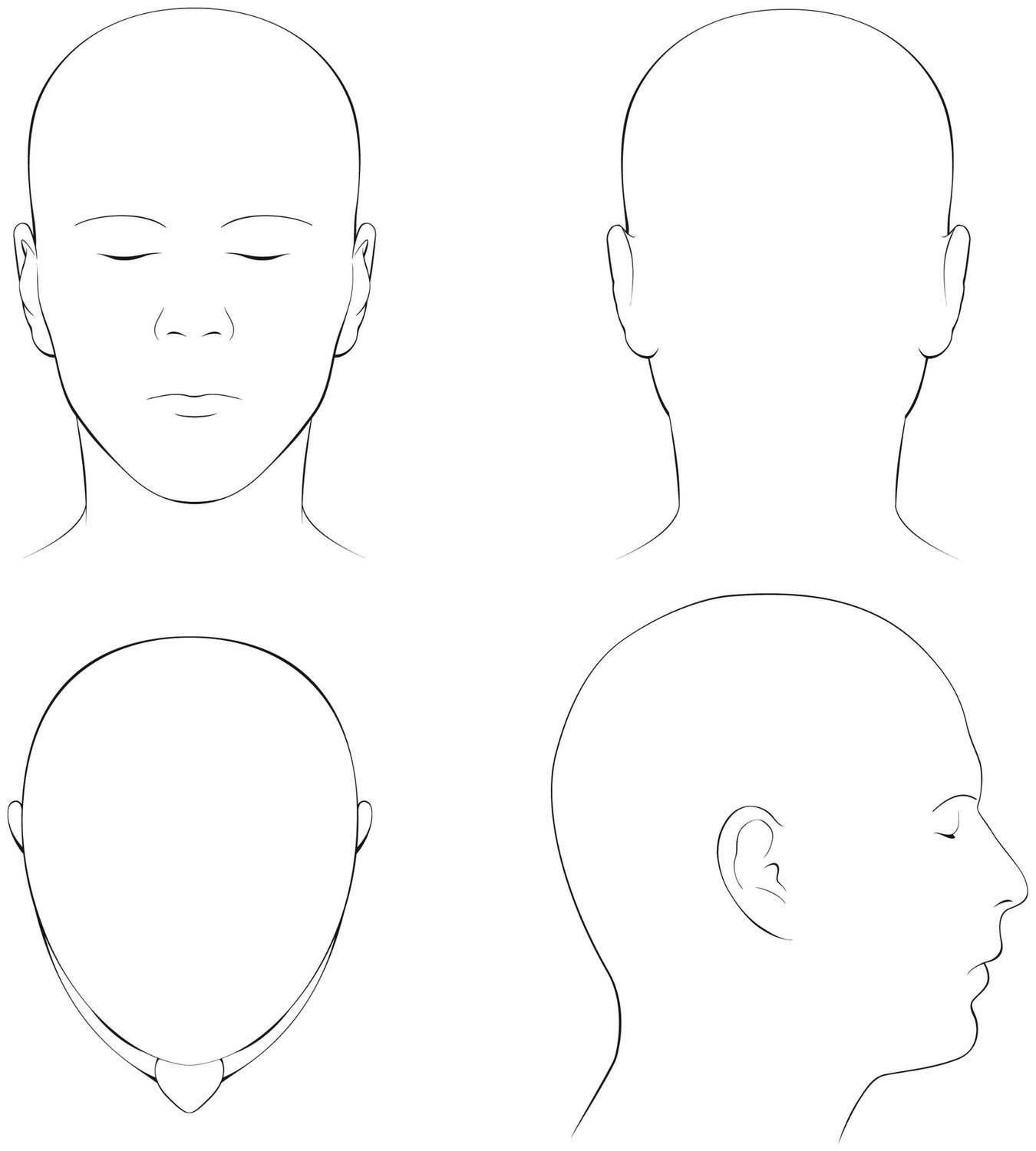
    Four blank head outlines in front, back, top and profile view, used to mark where headache pain is felt
    Tracing where the pain actually sits, rather than describing it, carries more diagnostic weight than severity does.

    The nerve, and where it is vulnerable

    The supraorbital nerve is a branch of the first division of the trigeminal nerve. It leaves the skull through the supraorbital notch or foramen — a gap you can feel on the upper rim of the eye socket, roughly a third of the way out from the midline — and fans out to supply the forehead and the front of the scalp.

    At that exit point it is close to the surface and lying against bone, with nothing over it but skin, muscle and eyebrow. A direct blow to the brow compresses the nerve against the orbital rim. That is the anatomy behind why this happens after an elbow in basketball, a fall onto the brow, a windshield or airbag impact, an assault, or a laceration repaired over the eyebrow. Surgery in the area, including brow lifts, can do the same thing.

    What it feels like

    Supraorbital neuralgia has a described diagnostic triad: forehead pain in the territory the nerve supplies, without switching sides; tenderness over the supraorbital notch or along the course of the nerve; and complete, though temporary, relief of the pain when the nerve is blocked with local anesthetic.1

    In a series of 18 patients followed over seven years, the pain was typically dull with short sharp or burning exacerbations, sitting in the forehead and around the eye. Five of the 18 had a history of trauma to the forehead on the same side. About two-thirds were women, average age at onset was 51.6 years, and by the time they were studied they had been in pain for an average of 5.9 years.2

    Two features point specifically toward a nerve injury rather than a primary headache:

    • It never changes sides. Migraine can favor one side but generally shifts at least occasionally. A pain rigidly locked to one side of the forehead over years is doing something different.
    • The skin over it behaves oddly. Numbness, pins and needles, or a forehead that hurts to light touch or to the brush of a hairbrush. Around half the cases identified in a population study had measurable sensory loss on the affected side.3 These sensory features, and sharp jabbing pains, are reported more often in the post-traumatic form than in cases with no injury behind them.1

    How common is it, really

    The literature describes supraorbital neuralgia as rare, and in headache clinics it is diagnosed rarely. A population study points the other way. Among 1,838 residents aged 18 to 65 in Vågå, Norway — 88.6% of those eligible — ten met the case definition, a prevalence of about 0.5%.3

    The case definition used in that study is worth reading closely, because trauma was built into it: unilateral forehead or eye pain, steadfastly one-sided, with increased tenderness over the nerve’s exit point, and preceding trauma to the forehead or supraorbital rim on the same side.3

    Half a percent of a general population is not rare. The likeliest reading of the gap is that the diagnosis is under-recognized rather than genuinely uncommon — people with a decades-old brow injury and a one-sided forehead headache are being carried under a different label. That is a single population, in one Norwegian valley, and the figure should be treated as one good estimate rather than a settled number.

    What it is mistaken for

    • Migraine. The overlap is real, and the two can coexist. Side-locking, a tender notch and sensory change on the forehead are the features that should prompt a second look — see migraine treatment.
    • Sinus headache. Frontal pain above the eye is routinely attributed to the frontal sinus. See is it a sinus headache or a migraine.
    • Cluster headache. Also strictly one-sided and centered around the eye, but with prominent tearing, nasal congestion and a striking circadian pattern that supraorbital neuralgia does not have — see migraine or cluster headache.
    • Post-concussive headache. A blow hard enough to injure the nerve may also have caused a concussion, and both can be present. One does not exclude the other.
    • Thyroid eye disease. In a review of 1,126 patients with thyroid eye disease, 8% reported a distinct pain suggestive of supraorbital neuralgia, and all of them had complete relief from a supraorbital nerve block.4 Worth knowing if there is eye protrusion or a thyroid history.

    Why the block is the test as well as the treatment

    There is no scan for this. The diagnosis is made from the pattern, the tender point, and the response to anesthetizing the nerve — complete relief while the anesthetic is working confirms that the pain is arising from that nerve.1 A negative result is equally informative: it says the pain is coming from somewhere else, and the diagnosis moves on.

    That is only true if the injectate reached the nerve. This is the reason every injection here is placed under imaging rather than by feel — see ultrasound and fluoroscopic guidance and why image guidance matters. A failed landmark block tells you nothing at all.

    Medication tends to disappoint here. In the 18-patient series, trials of various drugs including migraine and anti-neuralgic agents gave only slight relief, while anesthetic block of the nerve gave absolute relief for as long as it lasted.2 Relief frequently outlasts the pharmacology of the anesthetic, sometimes by weeks — see do nerve blocks for headache work and trigeminal nerve block.

    For the minority who do not respond durably to blocks, other options exist in the literature. Pulsed radiofrequency applied to the supraorbital nerve under ultrasound in 22 patients with refractory disease produced at least 50% pain reduction in 77% at one and three months, 73% at six months, 64% at one year and 50% at two years, with mild upper-eyelid bruising in about a quarter and no serious complications.5 That is a small, single-arm study with no control group, so treat it as encouraging rather than established.

    What to bring to the appointment

    • When the injury happened, and what hit you. Decades ago still counts.
    • Whether the pain has ever been on the other side. Be precise here; it carries more diagnostic weight than the severity.
    • Whether the forehead skin on that side feels different — numb, tingling, or too sensitive.
    • Anything already tried, including migraine treatments, and whether any of it helped.
    • Any scar over the eyebrow, and any surgery in the area.

    Common questions

    My eyebrow injury was years ago. Can it still be the cause?

    Yes. In one series the average time in pain before assessment was 5.9 years, and cases have been described far longer after the injury than that.2 A remote injury is a reason to examine the nerve, not to dismiss it. Contact us with the history and we can tell you whether it is worth assessing.

    How do I know if it is this and not migraine?

    The strongest clue is that the pain never moves to the other side, combined with a tender spot on the brow ridge and altered sensation on that side of the forehead.1 They can also coexist. See migraine or tension-type headache for how the primary headaches are separated from each other.

    Does the diagnostic block hurt, and will I need sedation?

    No sedation, and you drive yourself home. It is a superficial injection over the brow ridge and takes seconds. What to expect from a nerve block describes the same process at the back of the head.

    What if the block does not help at all?

    Then, provided it was image-guided, that is a useful result rather than a wasted visit — it means the pain is not arising from that nerve and the diagnosis moves elsewhere. See why image guidance matters.

    Will the numbness on my forehead come back?

    Sensory loss from the original injury may or may not recover, and treating the pain does not necessarily restore sensation. The anesthetic itself produces temporary numbness over the forehead that wears off in hours, which is the expected effect of blocking that nerve — see trigeminal nerve block.

    Sources

    1. Pareja JA, Caminero AB. Supraorbital neuralgia. Curr Pain Headache Rep. 2006;10(4):302-305. doi:10.1007/s11916-006-0036-9
    2. Caminero AB, Pareja JA. Supraorbital neuralgia: a clinical study. Cephalalgia. 2001;21(3):216-223. doi:10.1046/j.1468-2982.2001.00190.x
    3. Sjaastad O, Petersen HC, Bakketeig LS. Supraorbital neuralgia. Vågå study of headache epidemiology. Cephalalgia. 2005;25(4):296-304. doi:10.1111/j.1468-2982.2004.00856.x
    4. Patrinely JR, Hamilton KL, Parke RB, Patrinely JR, Soparkar CNS. Supraorbital neuralgia associated with thyroid eye disease. Ophthalmic Plast Reconstr Surg. 2021;37(3):230-235. doi:10.1097/IOP.0000000000001762
    5. Luo F, Lu J, Ji N. Treatment of refractory idiopathic supraorbital neuralgia using percutaneous pulsed radiofrequency. Pain Pract. 2018;18(7):871-878. doi:10.1111/papr.12687

    Being seen at Headache Express. We treat migraine, cluster and other severe headaches in St. Louis, usually the same day. Please contact us before coming in so the right treatment is ready when you arrive.

  • TMJ as a missed cause of headache

    If your headache sits in the temple, comes with jaw tightness, or is worse after a meal or a stressful night of clenching, the jaw is worth examining before anything else is added to your treatment. It is one of the most commonly missed contributors to headache, and one of the few that is easy to check in a few minutes.

    What a temporomandibular disorder actually is

    Temporomandibular disorder, or TMD, is not one condition. It covers problems of the temporomandibular joint itself, problems of the muscles that move the jaw, or both. In headache patients the muscular form dominates: in a study of 132 people with migraine, myofascial pain was the most prevalent form of TMD in both the episodic and chronic groups.1

    That matters, because a muscular problem does not show up on a jaw X-ray. People are sent for imaging, told the joint looks normal, and reasonably conclude the jaw was a dead end. The joint was never the question.

    Two different relationships, and the distinction changes the treatment

    There are two ways a jaw problem and a headache can be connected, and they are not the same thing.

    • The TMD is causing the headache. The International Classification of Headache Disorders recognizes this as a secondary headache, item 11.7, headache attributed to temporomandibular disorder.2 Treat the jaw and the headache should follow.
    • The TMD and a primary headache coexist. Migraine and tension-type headache are genuinely comorbid with TMD — having one raises the likelihood of the other.2 Here the jaw is a load on a system that already has a headache disorder, and both need addressing.

    Efforts to identify a distinctive fingerprint for the secondary type have largely failed. The most that can be said is that it tends to sit in one or both temples and to look either migraine-like or tension-type-like.2 So the label cannot be settled from the description of the pain alone, which is exactly why the jaw has to be examined rather than asked about.

    How common this is in people whose headaches have become frequent

    The association is strongest in the group that has the most to gain. In a single-center study of 90 people with chronic migraine and 42 with episodic migraine, TMD was present in 60% of the chronic group against 21.4% of the episodic group.1 A separate study from the same group, in 63 chronic and 40 episodic migraine patients, found 47.5% against 28.5%.3

    Both are modest, single-center samples and the exact percentages should not be read as precise. The direction is the consistent finding: the more frequent the headache, the more likely the jaw is involved. Frequent neck pain tracked the same way in the larger study, reported by 65.5% of the chronic group and 21.4% of the episodic group.1

    The relationship also runs the other way. A 2024 systematic review of cohort studies found that headache frequency, tension-type headache, migraine and mixed headache were themselves risk factors for developing TMD.4 Neither is simply causing the other; they feed each other.

    The chronification question

    The more consequential possibility is that untreated TMD helps push migraine from episodic toward chronic. This has been argued for over fifteen years, with cutaneous allodynia — tenderness of the scalp and face between attacks — proposed as the link.5 The evidence that TMD drives progression remains limited, and it would be overstating it to say the case is settled.

    But the practical conclusion does not depend on settling it. A treatable source of continuous input into the trigeminal system, in someone whose headaches are becoming more frequent, is worth removing on its own merits. If it also slows chronification, that is a second reason. See chronic or episodic migraine for why the 15-day line matters so much.

    Why it gets missed

    • Temple pain reads as tension-type headache. The temporalis is a chewing muscle. Pain from it lands exactly where people expect a stress headache to be — see migraine or tension-type headache.
    • The jaw is not examined in a standard headache visit. Palpating the masseter and temporalis and measuring jaw opening takes about two minutes and is frequently skipped.
    • Patients do not report it. Jaw clicking and morning tightness are not experienced as a headache symptom, so they are not mentioned unless asked.
    • A normal joint image closes the file. As above: the common form is muscular, and imaging of the joint does not exclude it.

    What you can check before your appointment

    None of this is diagnostic on its own, but it is worth arriving with the answers:

    • Does the pain start or worsen while chewing, especially something tough?
    • Is your jaw tight or sore on waking? That points toward clenching or grinding overnight.
    • Can you fit three of your own fingers, stacked vertically, between your upper and lower front teeth? Less than that suggests restricted opening.
    • Press firmly into the muscle at your temple and into the thick muscle at the angle of the jaw. Is one side clearly more tender?
    • Does the jaw click, catch, or deviate to one side as it opens?

    How this is handled here

    The jaw and the chewing muscles are examined as part of a headache assessment rather than as a separate referral. Where a muscular pain source in the temporalis or masseter is contributing, that is treatable, and it is treated alongside the headache disorder rather than instead of it — a simultaneous approach to both conditions outperforms treating either one on its own.2

    Where the joint itself, the bite, or nocturnal grinding is the primary driver, that is dentistry and orofacial pain territory, and we will say so and point you there rather than treat around it. Bruxism’s exact role in headache remains unclear even in the specialist literature.6

    If the neck is also involved — and in frequent headache it usually is — see is my headache coming from my neck and cervicogenic headache treatment.

    Common questions

    Can a jaw problem really cause a headache, or is that a myth?

    It is a formally recognized diagnosis. The International Classification of Headache Disorders lists headache attributed to temporomandibular disorder as item 11.7.2 What is genuinely uncertain is how often a jaw problem is the sole cause rather than one contributor alongside a primary headache disorder — see migraine or tension-type headache.

    My jaw X-ray was normal. Does that rule it out?

    No, and this is the most common reason the diagnosis is missed. The form most often found in headache patients is myofascial — a muscle problem, not a joint problem — and it does not appear on imaging of the joint.1 The examination is done with hands, not a scanner.

    Should I get a night guard?

    Possibly, but that decision belongs with a dentist, and a guard addresses grinding rather than headache directly. Bruxism’s role in headache is still not well defined.6 It is worth doing in parallel with headache treatment rather than as a substitute for it — contact us and we will tell you which order makes sense in your case.

    My headaches have become almost daily. Is the jaw worth checking at that point?

    That is exactly the group where it is most worth checking. TMD was found in 60% of chronic migraine patients against 21.4% of episodic in one study.1 Also check whether acute medication is sustaining the pattern — see medication-overuse headache.

    Do you inject the jaw?

    Where a muscular pain source is contributing, that is treatable, and any injection here is placed under imaging rather than by landmark — see ultrasound and fluoroscopic guidance. Whether an injection is the right step depends on what the examination shows, which is why the assessment comes first.

    Sources

    1. Latysheva N, Platonova A, Filatova E. Temporomandibular disorder and cervicalgia: pathophysiology underlying the comorbidity with chronic migraine. Zh Nevrol Psikhiatr Im S S Korsakova. 2019;119(1):17-22. doi:10.17116/jnevro201911901117
    2. Speciali JG, Dach F. Temporomandibular dysfunction and headache disorder. Headache. 2015;55(Suppl 1):72-83. doi:10.1111/head.12515
    3. Zenkevich AS, Filatova EG, Latysheva NV. Migraine and temporomandibular joint dysfunction: mechanisms of comorbidity. Zh Nevrol Psikhiatr Im S S Korsakova. 2015;115(10):33-38. doi:10.17116/jnevro201511510133-38
    4. Da-Cas CD, Valesan LF, Nascimento LP, et al. Risk factors for temporomandibular disorders: a systematic review of cohort studies. Oral Surg Oral Med Oral Pathol Oral Radiol. 2024;138(4):502-515. doi:10.1016/j.oooo.2024.06.007
    5. Bevilaqua Grossi D, Lipton RB, Bigal ME. Temporomandibular disorders and migraine chronification. Curr Pain Headache Rep. 2009;13(4):314-318. doi:10.1007/s11916-009-0050-9
    6. Romero-Reyes M, Bassiur JP. Temporomandibular disorders, bruxism and headaches. Neurol Clin. 2024;42(2):573-584. doi:10.1016/j.ncl.2023.12.010

    Being seen at Headache Express. We treat migraine, cluster and other severe headaches in St. Louis, usually the same day. Please contact us before coming in so the right treatment is ready when you arrive.

  • Headache red flags: when to go to the emergency room

    Most headaches are not dangerous. A small number are, and they are recognizable. If any of the following applies, go to an emergency department or call 911 — do not wait for an appointment here.

    Go now

    • Thunderclap onset. A headache that reaches maximum intensity within seconds to a minute. The speed of onset is the warning sign, independent of how severe it ends up being.
    • Headache with fever and a stiff neck, or with a new rash.
    • Any neurological change — weakness, numbness, trouble speaking, loss of vision, double vision, unsteadiness, confusion, or a seizure.
    • Headache after a head injury, particularly with vomiting, drowsiness or worsening.
    • A new headache in someone who is pregnant or recently gave birth.
    • A new or changed headache over the age of 50.
    • A new headache in someone immunosuppressed or with a history of cancer.
    • Headache with a red, painful eye and blurred vision.
    • Headache that is consistently worse lying down, on waking, or with coughing and straining.

    Why thunderclap is first on the list

    Because the speed of onset is what distinguishes it, and people routinely describe it in terms of severity instead. The question that matters is not “how bad was it” but “how long did it take to get that bad”. Seconds is the answer that requires emergency imaging.

    If you have had a headache like that — even if it settled, even if it was weeks ago and you feel fine now — it should be assessed.

    What we are, and what we are not

    Headache Express is an outpatient clinic. We treat migraine, cluster and other recurring headache disorders, usually the same day. We do not have emergency imaging, we are not open overnight, and we are not a substitute for an emergency department.

    The distinction is the point of the clinic rather than a limitation of it. An emergency department is the right place for a headache that might be a bleed, an infection or a stroke. It is a poor place for a headache you already know the name of — you wait among higher-acuity patients and often leave with a shot and a referral rather than a plan.

    If you arrive here with features from the list above, we will tell you plainly and send you to an emergency department. That is the correct outcome, not a wasted visit.

    What is not a red flag

    Reassurance is worth as much as warning, so: severe pain by itself is not a red flag. Cluster headache is among the most severe pain in medicine and is not dangerous. Nausea and vomiting during a migraine are expected. Visual aura that builds over five to twenty minutes and resolves within an hour is a recognized migraine feature.

    What matters is change — a headache that is new, different from your usual pattern, or accompanied by something neurological that does not resolve.

    If none of this applies

    Then you are in the right place. See migraine treatment, cluster headache treatment, or the full list of treatments. Please contact us before coming in.

    Common questions

    My headache is the worst I’ve ever had, but it built over an hour. Is that thunderclap?

    No. Thunderclap refers to onset within seconds. A severe headache that built over an hour is not thunderclap, though a new or unusually severe headache still deserves assessment. See contact us.

    I had a sudden severe headache last month and I’m fine now. Do I still need to be checked?

    Yes. A resolved thunderclap headache still warrants assessment, because some causes present with a warning event before a larger one. That is an emergency department or urgent medical review, not an outpatient headache appointment — once it has been excluded, contact us about the ongoing headache pattern.

    Is aura a warning sign?

    Typical visual aura builds over 5 to 20 minutes and resolves within an hour. Sudden-onset visual loss, aura that does not resolve, or aura appearing for the first time over 50 are different and need assessment. See migraine treatment.

    Should I go to the ER for a severe cluster attack?

    Cluster pain is extreme but not dangerous, and emergency departments are often poorly set up to treat it. The better answer is a plan — including home high-flow oxygen — so you are not dependent on an ER at 3am.

    Being seen at Headache Express. We treat migraine, cluster and other severe headaches in St. Louis, usually the same day. Please contact us before coming in so the right treatment is ready when you arrive.

    Separately from the emergency question, it is worth knowing which headaches warrant a scan at all and which do not — see when a headache actually needs a scan.

  • Chronic or episodic migraine? Why 15 days is the line

    Chronic migraine is a defined diagnosis, not a description of feeling unwell often: headache on 15 or more days a month for more than three months, with at least eight of those days having migraine features.1

    The line matters because treatment options change on either side of it, and because crossing it is usually a process you can interrupt.

    The criteria, precisely

    • Headache — of any type — on 15 or more days per month
    • Sustained for more than three months
    • On at least eight of those days, the headache has migraine features or responds to migraine-specific treatment
    • In a person who has had at least five prior migraine attacks

    Note that the 15 days counts all headache days, not just migraines. People routinely undercount by excluding the “small” ones, and that undercount is the reason many are told they do not qualify for treatments they in fact qualify for.

    How episodic becomes chronic

    Chronification is not random. The recognized contributors are worth knowing because most are modifiable:

    • Medication overuse — the largest single one. See medication-overuse headache.
    • Untreated or undertreated attacks, which appear to sensitize the system over time
    • Untreated mood and anxiety disorders, which independently predict progression
    • Poor or irregular sleep, including undiagnosed obstructive sleep apnea
    • Obesity and metabolic factors

    That list is also the intervention list. See headache prevention.

    What changes at the threshold

    Botox is indicated for chronic migraine and not for episodic — the trials in people below 15 days did not show benefit. That is the clearest example, and it is why counting honestly matters more than it seems.

    Acute treatment also changes character. Below the threshold, the priority is treating attacks well. Above it, treating every attack aggressively is part of what sustains the pattern, and the plan has to shift toward prevention and toward unwinding rebound.

    Chronic is not permanent

    The most useful thing to know is that people move back across the line. Reversion from chronic to episodic is common, particularly when medication overuse is addressed. Many people who arrive counting 20-plus headache days a month are counting far fewer some months later, and the largest single lever was usually the medicine cabinet rather than a new drug.

    The word “chronic” describes your current pattern. It is not a prognosis.

    Common questions

    Do I count days when the headache was mild?

    Yes. The 15-day criterion counts headache days of any type and any severity, not just severe migraine attacks. Undercounting mild days is the most common reason people are told they do not qualify. See Botox for chronic migraine.

    What if I’m at 12 or 13 days?

    Then you have high-frequency episodic migraine, which is the group most at risk of crossing over — and the group where prevention pays off most. See headache prevention.

    Can chronic migraine go back to episodic?

    Yes, and it commonly does, especially once medication overuse is addressed. See medication-overuse headache.

    How do I actually keep track?

    A paper calendar with a mark for any headache day and a note of every dose of anything taken. Simplicity matters more than detail — a system you abandon in a week is worse than a tick per day. Bring it in; see contact.

    Being seen at Headache Express. We treat migraine, cluster and other severe headaches in St. Louis, usually the same day. Please contact us before coming in so the right treatment is ready when you arrive.

    Sources

    1. Headache Classification Committee of the International Headache Society. ICHD-3, 1.3 Chronic migraine. ichd-3.org
  • Cluster headache and the years it takes to get diagnosed

    Cluster headache is one of the most severe pains in clinical medicine and one of the most delayed diagnoses. A systematic review and meta-analysis of eleven studies published in 2025 estimated the average delay from onset to diagnosis at 10.4 years.1

    Individual studies vary widely — reported figures include 6.2 years, 5.7 years, a median of 3 years, and 12.7 years in a population-based sample — which reflects real differences in populations and eras rather than disagreement about the problem.1 The direction is consistent: years, not months.

    Why it takes so long

    It looks like sinus disease

    The cranial autonomic features — a blocked or running nostril, a watering red eye, a drooping lid, all on the painful side — read as infection or allergy. People receive repeated antibiotic courses across successive bouts. See is it a sinus headache or a migraine.

    It looks like dental disease

    Pain centered behind or around the eye and radiating into the upper jaw leads to dental investigation, and sometimes to treatment. Pain that persists after that work is its own problem — see persistent pain after dental treatment.

    It gets called migraine

    One-sided severe headache is assumed to be migraine, and the assumption survives because nobody asks the two questions that would break it: how long does an attack last, and what do you do during one. See migraine or cluster headache.

    The remissions are misleading

    Episodic cluster comes in bouts with remission between. If a bout ends while you are waiting for an appointment — which it often does — the problem appears to have resolved, and the investigation stops.

    The three features that identify it

    A validated three-item screen developed at Houston Methodist — the Erwin Test for Cluster Headache — covers pain intensity, attack duration and autonomic features. In its validation study of 224 people with headache disorders, of whom 64 had cluster headache, the three items together had a sensitivity of 84% (95% CI 73–92) and a specificity of 89% (95% CI 84–94).2

    Translated into what to tell a clinician:

    • This is the worst pain I have ever had. Cluster is characteristically extreme, not merely bad.
    • Each attack is over within about three hours. ICHD-3 puts untreated attacks at 15 to 180 minutes.3
    • My eye waters and my nostril blocks, on the same side as the pain.

    Add the timing — attacks that arrive at the same hour, often waking you from sleep, from one every other day up to eight a day during a bout3 — and the picture is hard to mistake once someone is looking for it.

    What the delay costs

    Years of the wrong treatment, obviously. But also years of not being believed, which is its own injury. Cluster headache is sometimes called suicide headache — a name it earned from the elevated rate of suicidal thinking among people living with it untreated, not a figure of speech.

    If you are having thoughts of harming yourself, call or text 988 for the Suicide and Crisis Lifeline, 24 hours a day. Cluster headache is treatable and the pain is not a permanent condition of your life.

    Shortening it

    The fastest route through is a clinician who has seen it. Dr. Gurpreet Singh Padda, MD, MBA, MHP has lived with chronic cluster headache since the age of 17, so the pattern is recognized here rather than argued about. Treatment starts with high-flow normobaric oxygen, which is first-line and works within minutes when delivered correctly.

    See cluster headache treatment for the full picture.

    Common questions

    What should I bring to speed this up?

    A month of attack times to the hour, how long each lasted, which side, and what happened to your eye and nose. That single sheet does more than any scan. See contact.

    Does a normal MRI mean I don’t have cluster headache?

    No. Cluster is diagnosed from the attack pattern; imaging is used to exclude other causes and a normal result is expected. See cluster headache treatment.

    My bout ended before my appointment. Should I still come?

    Yes. Remission is part of episodic cluster, not evidence against it, and the time between bouts is when preventive planning and a home oxygen setup are best arranged. See oxygen therapy.

    Is cluster headache hereditary?

    There is a familial component in a minority of cases, but most people with cluster headache have no affected relative. A negative family history is not a reason to rule it out. See cluster headache treatment.

    Being seen at Headache Express. We treat migraine, cluster and other severe headaches in St. Louis, usually the same day. Please contact us before coming in so the right treatment is ready when you arrive.

    Sources

    1. Peng K-P, et al. Cluster headache diagnostic delay and its predictors: a systematic review with a meta-analysis. The Journal of Headache and Pain, 2025. link.springer.com
    2. Parakramaweera R, Evans RW, Schor LI, et al. A brief diagnostic screen for cluster headache: creation and initial validation of the Erwin Test for Cluster Headache. Cephalalgia, 2021. PMID 34148408. pubmed.ncbi.nlm.nih.gov
    3. Headache Classification Committee of the International Headache Society. ICHD-3, 3.1 Cluster headache. ichd-3.org
  • Is your headache coming from your neck?

    If your headache is reliably brought on by neck position or sustained desk posture, stays on the same side, and lacks nausea and throbbing, the generator may be in your neck rather than your head.

    Medical illustration of the head and neck in profile showing cranial and cervical nerve pathways in yellow, with a shaded area of pain across the front of the head
    Cervical and cranial nerve pathways converge in the upper neck, which is why a problem there is felt at the front of the head.

    This matters because treating the head does not fix a neck problem. People cycle through migraine medications for years without touching the actual source.

    How cervicogenic headache presents

    • Pain that starts in the neck or at the base of the skull and is referred forward — over the back of the head, behind the ear, sometimes to the forehead or around the eye
    • Usually one-sided, and it stays on that side — it does not alternate the way migraine can
    • Provoked by neck movement or position, or by pressure over the upper cervical joints
    • Reduced range of neck motion on the affected side
    • A deep ache rather than electric jolts, and without the marked scalp tenderness of occipital neuralgia

    ICHD-3 requires evidence that the headache is attributable to a disorder of the cervical spine or soft tissues of the neck, and lists two ways of showing it: the headache develops in temporal relation to the neck disorder, or the headache is abolished by a diagnostic blockade of a cervical structure or its nerve supply.1

    That second criterion is the important one, and it is the whole reason diagnostic blocks exist for this condition.

    Which structures refer pain into the head

    The atlanto-axial joint (C1–C2)

    The joint that lets you shake your head “no” carries more rotation than any other in the neck, and it refers pain to the back of the head and behind the ear. It is frequently missed, because it sits above the levels most cervical imaging and most injections address. An atlanto-axial injection reaches it, under fluoroscopy with contrast confirmation — the vertebral artery and the C2 nerve root are immediately adjacent, so this one is never done blind.

    The upper cervical facet joints

    C2–C3 in particular refers into the occipital region. Diagnostic medial branch blocks establish whether these joints are the source.

    The occipital nerves

    Not a joint, but the pathway. An occipital nerve block is often the first step because it is quick, low-risk under ultrasound, and immediately informative.

    Why whiplash shows up years later

    Cervicogenic headache frequently follows a neck injury, and the gap between the injury and the headache can be months. People do not connect the two, and neither does the clinician who was not told about the accident. If you have had whiplash at any point, mention it even if it seems ancient history.

    What the treatment plan looks like

    An image-guided block first, to establish the source. If the block abolishes the pain, you have a target and the longer-term options become reasonable. If it does not, the diagnosis moves and you have not wasted months.

    Physical therapy directed at the upper cervical spine does much of the durable work. Injections buy the window in which that becomes possible — treating a neck that hurts too much to move is not productive.

    Everything here is placed under ultrasound or fluoroscopic guidance. With a diagnostic block, guidance is not a refinement: an unguided block that fails tells you nothing, because it may simply have missed.

    Common questions

    Can neck arthritis on an X-ray prove my headache is cervicogenic?

    No. Degenerative changes are extremely common in people with no headache at all. ICHD-3 requires either a temporal relationship or abolition by a diagnostic block — imaging findings alone are not sufficient. See cervicogenic headache treatment.

    I get neck pain with my migraines. Does that make them cervicogenic?

    Usually not. Neck symptoms are very common during migraine attacks and are part of the migraine itself. The distinguishing feature is whether neck movement provokes the headache rather than accompanying it. See migraine treatment.

    What if the block only helps a little?

    A partial response is genuinely ambiguous and we treat it that way. It may mean more than one structure is contributing, or that the targeted structure is not the main generator. See image guidance for why a guided block makes a negative result trustworthy.

    Is this the same as occipital neuralgia?

    No. Occipital neuralgia is electric, shooting pain with marked scalp tenderness; cervicogenic headache is a deeper referred ache provoked by neck position. They overlap and a block often separates them — see occipital neuralgia treatment.

    Being seen at Headache Express. We treat migraine, cluster and other severe headaches in St. Louis, usually the same day. Please contact us before coming in so the right treatment is ready when you arrive.

    Sources

    1. Headache Classification Committee of the International Headache Society. ICHD-3, 11.2.1 Cervicogenic headache. ichd-3.org
  • Occipital neuralgia or migraine?

    Two features point at occipital neuralgia rather than migraine: the pain is electric and shooting rather than throbbing, and the scalp over the nerve is tender enough that a hairbrush, a hat or a pillow hurts.

    The confusion is understandable. Occipital neuralgia is one-sided, it can radiate forward as far as behind the eye, and it can be severe — three things people associate with migraine. But the quality of the pain and the scalp findings are different, and so is the treatment.

    What occipital neuralgia actually is

    The greater and lesser occipital nerves carry sensation from the back of the head. When one is irritated or compressed, the result is paroxysms of stabbing or shock-like pain in that nerve’s territory — from the top of the neck, over the back of the head, sometimes forward to the eye on the same side. Between the jolts there is often a persistent background ache.

    ICHD-3 describes it as unilateral or bilateral paroxysmal shooting or stabbing pain in the distribution of the occipital nerves, with dysaesthesia or allodynia during innocuous stimulation of the scalp, and tenderness over the affected nerve.1 That last part — tenderness over the nerve — is the thing to check.

    Side by side

    Points to occipital neuralgia

    • Electric, shooting, stabbing paroxysms — not a throb
    • Pain running from the base of the skull upward, following the nerve
    • Scalp allodynia: brushing hair, wearing a hat, or lying on a pillow hurts
    • Pressing where the nerve emerges below the skull base reproduces the pain
    • Relief when the nerve is anesthetized

    Points to migraine

    • Pulsating, building over minutes to hours
    • Nausea, or sensitivity to both light and sound
    • Made worse by routine physical activity
    • Attacks lasting 4 to 72 hours
    • A history of aura in some people

    Scalp sensitivity is where people get caught out, because migraine also produces cutaneous allodynia during attacks. The difference is that in occipital neuralgia the tenderness is focal — over one nerve, present between attacks — while migraine allodynia is diffuse and tracks the attack.

    The block that is also a test

    This is the useful part. An occipital nerve block places local anesthetic directly around the nerve. If the pain goes, that nerve was the source, which both treats the episode and settles the diagnosis. If it does not go, the pain is arising somewhere else and the diagnosis needs to move — most often toward cervicogenic headache or migraine.

    That logic only holds if the injection actually reached the nerve, which is why we place these under ultrasound guidance. The occipital artery runs alongside the nerve; ultrasound shows both, keeps the needle away from the vessel, and means a block that fails is information rather than a possible miss.

    Relief commonly outlasts the anesthetic by weeks — longer than the pharmacology alone explains. There is no fixed course of three. The interval is set by how long the last one held and by what is happening clinically.

    Where the two overlap

    Occipital nerve blocks are also used in migraine and in cluster headache, which can make the picture look muddier than it is. The occipital nerves converge on the same trigeminocervical relay that generates migraine pain, so blocking them can modulate a migraine even when the occipital nerve is not the primary generator.

    So a partial response does not confirm occipital neuralgia. A complete abolition of the pain in the nerve’s territory, in someone with focal tenderness over that nerve, does.

    Common questions

    Is occipital neuralgia the same as a pinched nerve in the neck?

    No, though they can coexist. Occipital neuralgia is irritation of the occipital nerve itself; cervical radiculopathy is compression of a nerve root in the neck. Pain referred from the upper cervical joints is a third thing — see cervicogenic headache.

    Do I need an MRI first?

    Not usually. Occipital neuralgia is diagnosed clinically from the pain pattern, the focal tenderness and the response to a block. Imaging is used to exclude other causes when the history suggests them. See occipital neuralgia treatment.

    How long does the relief last?

    It varies widely between people. The anesthetic wears off in hours but relief often persists for weeks. We time the next block by how long the last one held, not by a schedule. See occipital nerve block.

    Does the injection hurt?

    The needle is fine and the injection takes seconds. Scalp numbness over the back of the head afterwards is expected and wears off over several hours. There is no sedation and you drive yourself home. See occipital nerve block.

    Being seen at Headache Express. We treat migraine, cluster and other severe headaches in St. Louis, usually the same day. Please contact us before coming in so the right treatment is ready when you arrive.

    Sources

    1. Headache Classification Committee of the International Headache Society. ICHD-3, 13.4 Occipital neuralgia. ichd-3.org
  • Migraine or tension-type headache?

    One question separates them better than any other: does routine physical activity make it worse? Migraine is aggravated by movement. Tension-type headache is not.

    The distinction matters because migraine responds to migraine-specific treatment and tension-type headache largely does not. A great many headaches labeled “tension” are in fact mild migraine, and the wrong label leads to years of the wrong drug.

    The two profiles side by side

    Tension-type headache

    • Both sides of the head
    • Pressing or tightening quality — a band around the head, a weight on top of it — not pulsating
    • Mild to moderate intensity; most people carry on working
    • Not aggravated by walking or climbing stairs
    • No nausea. Light or sound sensitivity may occur, but not both

    Those five points are the ICHD-3 criteria almost verbatim: at least two of bilateral location, pressing/tightening quality, mild or moderate intensity, and no aggravation by routine activity — plus no nausea or vomiting, and no more than one of photophobia or phonophobia.1

    Migraine

    • Often but not always one-sided
    • Pulsating rather than pressing
    • Moderate to severe — enough to interfere
    • Made worse by routine physical activity, which is why people keep still
    • Nausea, or sensitivity to both light and sound
    • Lasts 4 to 72 hours untreated

    Migraine requires at least two of the first four and at least one of the last two.2 Note how the activity question appears on both lists with opposite answers — that is not a coincidence, it is the cleanest single discriminator.

    When the label is wrong

    If a “tension headache” ever forces you into a dark room, or comes with nausea, or stops you doing something you wanted to do, it was never a tension-type headache. Mild migraine is routinely misfiled this way, particularly in people who have never had a severe attack and so have nothing to compare it against.

    The other frequent impostor is cervicogenic headache — pain referred from the neck. If your headache tracks with neck position, desk posture, or an old neck injury, that is the thread to pull. A diagnostic occipital nerve block can settle it, because a block that abolishes the pain tells you where it was coming from.

    The rebound trap

    Because tension-type headache is mild enough to treat with whatever is in the cupboard, it is the headache most likely to end in medication-overuse headache. ICHD-3 sets the thresholds precisely: simple analgesics on 15 or more days a month, or triptans, ergots, opioids or combination analgesics on 10 or more days a month, sustained for more than three months, in someone who already has a headache disorder.3

    Cross that line and you get a daily headache that looks like worsening tension-type headache and is in fact the treatment. It is common, it is reversible, and it is the first thing to address — see headache prevention.

    What we do for it

    Frequent or chronic tension-type headache is usually not an infusion problem. It is a diagnosis problem, a rebound problem, or a neck problem, and the work is establishing which. Where there is genuine occipital or cervical involvement, an occipital nerve block is both treatment and diagnostic test, placed under ultrasound guidance so that a negative result is trustworthy.

    If the real diagnosis turns out to be migraine, the plan changes entirely — see migraine treatment.

    Common questions

    Can stress cause tension-type headache?

    Stress is a common trigger, but tension-type headache is not simply “a headache from being stressed” and it is not psychological. Nor does a stress trigger make a headache tension-type rather than migraine — stress triggers migraine too. See tension-type headache treatment.

    I have headaches most days. Which is it?

    Frequency alone does not decide it — both chronic migraine and chronic tension-type headache exist. What matters first is how often you are treating, because medication overuse changes everything downstream. See headache prevention.

    Does neck and shoulder tightness mean it’s tension-type?

    Not necessarily. Neck symptoms are extremely common in migraine, and pain arising from the upper cervical joints is cervicogenic headache, a third diagnosis with its own treatment.

    Will Botox help my tension headaches?

    Botox is approved and evidenced for chronic migraine, not for tension-type headache. If you have been offered it for tension headache, the diagnosis is worth revisiting first — see Botox for chronic migraine.

    Being seen at Headache Express. We treat migraine, cluster and other severe headaches in St. Louis, usually the same day. Please contact us before coming in so the right treatment is ready when you arrive.

    Sources

    1. Headache Classification Committee of the International Headache Society. ICHD-3, 2. Tension-type headache. ichd-3.org
    2. Headache Classification Committee of the International Headache Society. ICHD-3, 1.1 Migraine without aura. ichd-3.org
    3. Headache Classification Committee of the International Headache Society. ICHD-3, 8.2 Medication-overuse headache. ichd-3.org
  • Is it a sinus headache or a migraine?

    If you have recurring “sinus headaches” without fever or discolored nasal discharge, migraine is the more likely explanation — and it is treatable. Sinus pain is one of migraine’s own symptoms, not evidence against it.

    This is one of the most common misroutings in headache care. People spend years on decongestants, antihistamines and repeated antibiotic courses for a condition that antibiotics cannot touch.

    Why migraine feels like sinus disease

    The trigeminal nerve supplies both the sinuses and the meninges. When the trigeminal system is activated during a migraine, the pain is referred across that whole territory — which includes the cheek, the bridge of the nose, and behind the eye. It genuinely feels like pressure in the sinuses, because the same nerve reports both.

    Migraine also produces cranial autonomic symptoms in a substantial minority of people: nasal congestion, a runny nose, watering eyes. Those are the exact symptoms that make people reach for a decongestant.

    Add the weather trigger — barometric pressure change is a well-recognized migraine trigger and also what people associate with sinus trouble — and the misattribution becomes almost inevitable.

    What actually distinguishes them

    Points toward migraine

    • Attacks that come and go over hours and then fully resolve, leaving you well between them
    • Nausea, or sensitivity to light or sound
    • Pain made worse by routine physical activity such as climbing stairs
    • A history of “sinus headaches” that respond to a triptan or to lying down in the dark
    • No fever and no thick discolored discharge

    Points toward genuine bacterial sinusitis

    • Fever
    • Purulent, discolored nasal discharge
    • Symptoms that persist continuously for more than ten days without improving, or worsen after initially improving
    • Facial pain and congestion that do not remit between episodes

    Acute bacterial sinusitis is an illness with a beginning and an end. Migraine is a recurring attack disorder with well periods in between. The pattern over months separates them more reliably than any single symptom.

    The diagnostic criteria are explicit about this

    The International Classification of Headache Disorders is direct: headache attributed to rhinosinusitis requires clinical, endoscopic or imaging evidence of the sinus disease, and the headache must develop in temporal relation to it and resolve as it resolves.1 Chronic or recurring sinusitis is not accepted as a cause of recurrent headache unless there is a demonstrated acute exacerbation. In other words, “chronic sinus headache” as a standing diagnosis is not a recognized entity.

    Migraine, by contrast, requires attacks lasting 4 to 72 hours with at least two of: one-sided location, pulsating quality, moderate or severe intensity, or aggravation by routine activity — plus either nausea/vomiting or both photophobia and phonophobia.2 Read those criteria against your own “sinus” attacks and the fit is often immediate.

    The other thing hiding under the sinus label

    One-sided facial pain with a blocked nostril and a watering eye, arriving at the same hour and lasting under three hours, is not migraine either. That is cluster headache, and it is misdiagnosed as sinus disease even more often than migraine is. If your “sinus headaches” are always on the same side and always at the same time of day, read that page instead.

    Persistent pain in the upper teeth or cheek after dental work is a third possibility — see persistent pain after dental treatment.

    What treatment actually looks like

    If the diagnosis is migraine, the plan is migraine-specific. For an attack that has not broken with oral medication, intravenous therapy removes absorption from the equation. For attacks with a strong autonomic component — the ones that feel most “sinus-like” — an SPG block targets the relay behind the nose directly, with no needle and no sedation.

    If you have been treating these headaches most days with decongestants or combination painkillers, read headache prevention first. Frequent acute dosing can sustain the very headache you are treating.

    Common questions

    My CT scan showed sinus changes. Doesn’t that prove it’s sinus?

    Not on its own. Incidental mucosal thickening is common in people with no facial pain at all. ICHD-3 requires the headache to develop in time with the sinus disease and resolve as it resolves. See migraine treatment.

    Why did antibiotics seem to help last time?

    Migraine attacks end on their own, usually within 4 to 72 hours, which is about the time a course starts. Improvement that coincides with an antibiotic is not evidence the antibiotic caused it. See migraine treatment.

    Can weather changes really trigger migraine?

    Barometric pressure change is a recognized migraine trigger, and it is also what most people attribute to sinuses — which is part of why the two get confused. See headache prevention.

    I get facial pain and a runny nose with mine. Isn’t that sinus?

    Cranial autonomic symptoms occur in migraine and are prominent in cluster headache. They point at the trigeminal-autonomic system, not at infection. See cluster headache treatment.

    What if I actually do have sinusitis?

    Then you need it treated as an infection, and we will tell you so. This clinic treats headache disorders; a genuine acute bacterial sinusitis belongs with primary care or ENT. Contact us if you are unsure which you have.

    Being seen at Headache Express. We treat migraine, cluster and other severe headaches in St. Louis, usually the same day. Please contact us before coming in so the right treatment is ready when you arrive.

    Sources

    1. Headache Classification Committee of the International Headache Society. ICHD-3, 11.5 Headache attributed to disorder of the nose or paranasal sinuses. ichd-3.org
    2. Headache Classification Committee of the International Headache Society. ICHD-3, 1.1 Migraine without aura. ichd-3.org
  • Migraine or cluster headache? How to tell the difference

    Four things separate them: which side, how long, what you do during the attack, and whether your eye and nose react on the painful side. You can check all four against your own history before you see anyone.

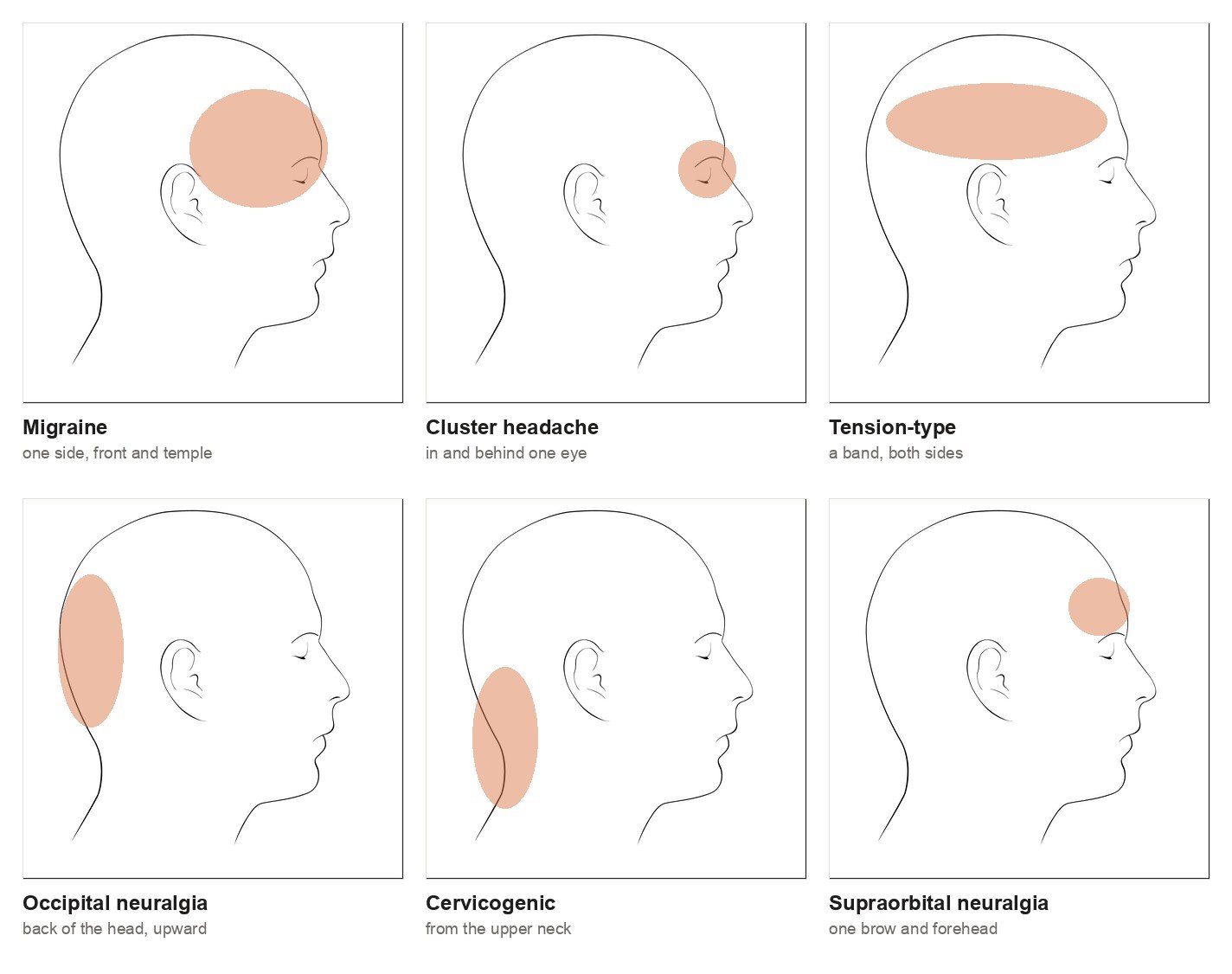
    Six head-profile diagrams showing where each headache type is typically felt: migraine over one side and temple, cluster headache in and behind one eye, tension-type as a band across both sides, occipital neuralgia at the back of the head, cervicogenic headache from the upper neck, and supraorbital neuralgia over one brow and forehead
    Where each type is typically felt. These are the usual patterns, not rules — overlap is common, and more than one can be present at once. Location narrows the question; it does not settle it on its own.

    This matters more than most diagnostic questions, because the treatments barely overlap. High-flow oxygen aborts a cluster attack and does nothing for migraine. Getting the label wrong costs years — a 2025 systematic review and meta-analysis of eleven studies put the average delay to a cluster headache diagnosis at 10.4 years.1

    The four discriminators

    1. Which side

    Cluster pain is strictly one-sided, centered in or behind one eye or over one temple, and it stays on that side within a bout. Migraine is often one-sided but does not have to be — a bilateral migraine is still a migraine. That asymmetry is a rule for cluster and only a tendency for migraine.

    2. How long

    This is the cleanest discriminator. Under the International Classification of Headache Disorders, 3rd edition, an untreated cluster attack lasts 15 to 180 minutes and reaches full intensity within minutes.2 An untreated migraine attack lasts 4 to 72 hours and builds more gradually.3 If your attacks are reliably over inside three hours, migraine becomes unlikely.

    Cluster also has a frequency pattern migraine does not: from one attack every other day up to eight per day during an active bout,2 often striking at the same hour and waking people from sleep.

    3. What you do during the attack

    Migraine drives people to lie still in a dark, quiet room, because movement makes it worse. Cluster does the opposite: restlessness is part of the diagnostic criteria, and people pace, rock, or press a fist into the eye socket.2 Clinicians ask where it hurts far more often than they ask what you do while it hurts, and the second question is frequently more useful.

    4. Does your eye and nose react?

    Cluster attacks come with cranial autonomic features on the painful side: a watering or reddened eye, a drooping or swollen eyelid, a constricted pupil, a blocked or running nostril, facial sweating.2 These are not incidental — they are the reason cluster is so often mistaken for sinus disease.

    Why cluster gets called sinusitis

    A one-sided headache with a blocked nose, a running nostril and a red watering eye looks exactly like an infection to almost everyone, including clinicians who do not see cluster often. People are treated with repeated antibiotic courses through bout after bout.

    Two features break the tie. The pain is always the same side, and it keeps time — the same hour, night after night. Sinus infections do not behave that way. If you have had several courses of antibiotics for “sinus headaches” that are always left-sided or always right-sided and always start in the early hours, bring that history in.

    A screening question set that has been validated

    Researchers at Houston Methodist developed a three-item screen, the Erwin Test for Cluster Headache, from a larger questionnaire. In their validation study of 224 people with headache disorders — 64 of whom had cluster headache — the three items together had a sensitivity of 84% (95% CI 73–92) and a specificity of 89% (95% CI 84–94).4 The items cover pain intensity, attack duration and autonomic features: the same three things above.

    A screening tool is not a diagnosis. It is a reason to be taken seriously by the next clinician you see.

    The treatments are not interchangeable

    For cluster, high-flow normobaric oxygen is a first-line abortive with strong randomized evidence, and it is not a migraine treatment. A greater occipital nerve block can interrupt a bout, and an SPG block targets the autonomic relay responsible for the tearing and congestion.

    For migraine, the tools are different: intravenous therapy for an attack that has not broken, and Botox as a preventive if you are at 15 or more headache days a month.

    Dr. Gurpreet Singh Padda, MD, MBA, MHP has lived with chronic cluster headache since the age of 17. You will not have to persuade anyone here that a headache can be this bad.

    Common questions

    Can I have both migraine and cluster headache?

    Yes, and it is not rare. Having one does not exclude the other, and a person can have separate attack types with different treatment plans. Track them separately in a diary — see migraine treatment and cluster headache treatment.

    Does a normal MRI rule out cluster headache?

    No. Cluster headache is a clinical diagnosis made from the attack pattern, not from imaging. Imaging is used to exclude other causes, and a normal scan is the expected finding. See cluster headache treatment.

    If oxygen helps, does that confirm cluster?

    It is supportive, not proof. High-flow oxygen aborting attacks fits cluster well, and it does not treat migraine — but the flow rate and mask have to be right or the test is meaningless. See oxygen therapy.

    My headache is one-sided but lasts all day. Is that cluster?

    Unlikely on duration alone. Untreated cluster attacks run 15 to 180 minutes. An all-day one-sided headache fits migraine, cervicogenic headache or occipital neuralgia better.

    What should I bring to the appointment?

    A month of attack times, how long each lasted, which side, and every medication you took including over-the-counter. How often you are treating is one of the most useful facts you can give us — see contact.

    When it is an emergency

    None of the above applies to a headache that reaches maximum intensity within seconds, a headache with fever and a stiff neck, any weakness, numbness, trouble speaking, vision loss or confusion, or a headache after a head injury. Those need an emergency department. Headache Express is an outpatient clinic, not an emergency room — call 911.

    Being seen at Headache Express. We treat migraine, cluster and other severe headaches in St. Louis, usually the same day. Please contact us before coming in so the right treatment is ready when you arrive.

    Sources

    1. Peng K-P, et al. Cluster headache diagnostic delay and its predictors: a systematic review with a meta-analysis. The Journal of Headache and Pain, 2025. link.springer.com
    2. Headache Classification Committee of the International Headache Society. ICHD-3, 3.1 Cluster headache. ichd-3.org
    3. Headache Classification Committee of the International Headache Society. ICHD-3, 1. Migraine. ichd-3.org
    4. Parakramaweera R, Evans RW, Schor LI, et al. A brief diagnostic screen for cluster headache: creation and initial validation of the Erwin Test for Cluster Headache. Cephalalgia, 2021. PMID 34148408. pubmed.ncbi.nlm.nih.gov