
Most headaches do not need a scan. Imaging is warranted after head trauma, for a sudden or thunderclap onset, a new headache at 50 or over, a neurological deficit, or a headache brought on by coughing, exertion or sex. Outside an emergency, MRI is the test.
If nobody has scanned your head, that is usually the correct decision rather than a corner being cut. It is also the single most common thing people arrive here suspicious about. So it is worth explaining properly.
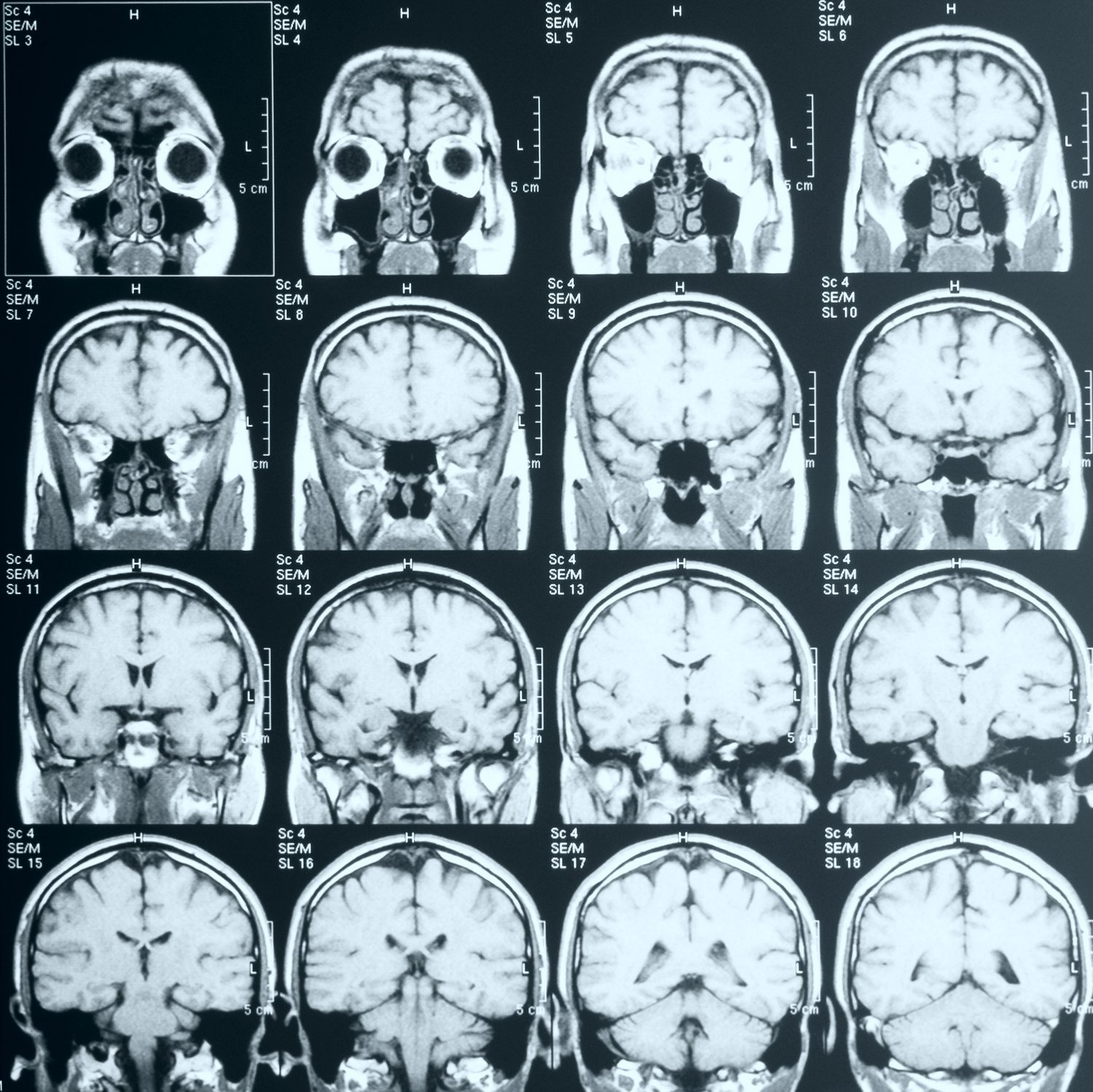
What the guidelines actually say
The American Headache Society’s Choosing Wisely list opens with it: do not perform neuroimaging in patients with stable headaches that meet criteria for migraine.1 The American College of Radiology reaches the same conclusion from the imaging side — most patients with uncomplicated, non-traumatic, primary headache do not require imaging.2
This is not a cost-cutting position dressed up as evidence. Take a headache that fits a primary pattern, with a normal neurological examination. There, a scan is overwhelmingly likely to be normal. And a normal scan does not change the treatment. What changes the treatment is the diagnosis. The diagnosis is made from the history and the examination.
When does a headache need a scan?
The features that shift the balance are specific and worth knowing. The ACR lists headaches that are:2,3
- Associated with head trauma.
- New, worse, or abrupt in onset — including thunderclap headache, which reaches maximum intensity within seconds.
- Persistent and positional — clearly worse lying down, or clearly worse standing up.
- Radiating to the neck.
- Accompanied by a neurological deficit on examination, or by optic disc swelling.
- New in someone aged 50 or over, particularly temporal headache.
- Occurring in specific contexts — pregnancy, cancer, an immunocompromised state, or a systemic illness including a clotting disorder.2,3
The three most people do not expect
Headaches brought on by coughing, by exertion, or by sexual activity usually require MRI of the brain with and without contrast. This is done to exclude underlying pathology before a primary headache syndrome is diagnosed.2
That is worth reading twice. That is because these are exactly the headaches people are least likely to mention. A headache that only happens when you cough, or when you lift, or during sex, feels embarrassing or trivial rather than alarming. It is the reverse. Tell us about it.
MRI or CT
Where imaging is indicated and it is not an emergency, MRI is the right test. The Choosing Wisely list is explicit: do not perform CT for headache when MRI is available, except in emergency settings.1 CT is fast, and it is very good at finding acute bleeding. That is why it is the emergency test. It involves ionizing radiation. And it is far less sensitive for most of what else might be found.
What does a normal brain scan rule out?
A normal scan rules out a structural lesion. It does not rule out migraine, cluster headache, occipital neuralgia, cervicogenic headache or medication-overuse headache — none of which are visible on imaging at all. Every one of those is diagnosed clinically.
So a normal MRI is not a dead end. It is not a statement that nothing is wrong. It is the expected result. It moves the question to where it belonged: which primary headache disorder is this, and what drives it. See migraine or tension-type headache and occipital neuralgia or migraine.
The case against scanning everyone
Yield (how often a scan finds something useful) is the first argument. In children with recurrent headache and a normal neurological examination, neuroimaging produces actionable findings in roughly 0 to 4.1% of cases.4 That is a pediatric figure and should not be read as an adult number. But the direction holds across the literature, and it is the basis for the guidelines above.
The second is what a scan finds that has nothing to do with your headache. Incidental findings are common. They generate follow-up imaging and specialist referrals. And they cause real anxiety over something that was never causing symptoms. Picture a test that is very unlikely to explain your problem and reasonably likely to raise an unrelated one. That test is not a neutral act.
The third is time. Waiting on a scan that was never going to change the plan is time not spent treating the headache.
What we do instead
We examine you, which includes the parts frequently skipped — the neck, the jaw, the occipital nerves and the exit points of the superficial trigeminal branches. See is my headache coming from my neck and TMJ as a missed cause of headache.
Where the source is genuinely uncertain, an image-guided diagnostic block answers a question a scan cannot. If anesthetizing (numbing) a specific nerve abolishes the pain, that nerve is carrying it. If it does not, the pain arises elsewhere. That is a functional test rather than a structural one. And headache is a functional problem — see do nerve blocks for headache work and why image guidance matters.
And if anything in your history or examination puts you in the list above, we say so and arrange the imaging. The point is not that scans are unnecessary. It is that they should be aimed.
Common questions
Should I ask for an MRI?
Ask what in your history or examination would make one useful. If the answer is nothing, a scan is very unlikely to change your treatment.1,2 If you have any of the features listed above, say so explicitly — contact us with the detail.
My headaches are severe. Does severity justify a scan?
Severity on its own is not one of the features that predicts a finding. Abrupt onset, a change in pattern, a positional element, or an abnormal examination are. Severe pain from a primary headache disorder is still a primary headache disorder — see headache red flags for what does warrant urgent attention.
I had a normal CT in the emergency department. Is that enough?
For excluding acute bleeding, usually yes, and that is what it was for. It is much less sensitive for other findings. That is why MRI is preferred outside emergencies.1 Whether anything further is needed depends on your pattern.
Only my cough brings it on. Is that worth mentioning?
Yes, specifically. Cough, exertional and sexual-activity headaches usually warrant MRI with and without contrast before being called primary.2 These are the ones people most often leave out.
Will you order the scan, or does my primary care doctor?
Either. If imaging is indicated we will arrange it or coordinate with whoever is best placed to. Note that authorization timelines and same-day treatment do not run on the same clock — see the coverage note on any of our treatment pages.
Can an MRI detect migraine or other headaches?
No. A normal scan excludes a structural lesion. But migraine, cluster headache, occipital neuralgia, cervicogenic headache and medication-overuse headache are not visible on imaging at all. Each is diagnosed clinically, from the history and the examination. So a normal MRI is the expected result, not a statement that nothing is wrong.
Is it worth getting an MRI for headaches?
Only when something in your history or examination points to it. Take a headache that fits a primary pattern with a normal neurological examination. A scan is overwhelmingly likely to be normal and does not change the treatment. It can also turn up incidental findings that bring more imaging and real anxiety. It is worth it after head trauma, with a thunderclap onset, a new headache at 50 or over, or a neurological deficit.
Which is better for headaches, a CT scan or an MRI?
Outside an emergency, MRI. The Choosing Wisely list says not to perform CT for headache when MRI is available, except in emergency settings. CT is fast and very good at finding acute bleeding. That is why it is the emergency test. But it involves ionizing radiation and is far less sensitive for most of what else might be found.
Sources
- Loder E, Weizenbaum E, Frishberg B, Silberstein S. Choosing wisely in headache medicine: the American Headache Society’s list of five things physicians and patients should question. Headache. 2013;53(10):1651-1659. doi:10.1111/head.12233
- Douglas AC, Wippold FJ, Broderick DF, et al. ACR Appropriateness Criteria Headache. J Am Coll Radiol. 2014;11(7):657-667. doi:10.1016/j.jacr.2014.03.024
- Whitehead MT, Cardenas AM, Corey AS, et al. ACR Appropriateness Criteria® Headache. J Am Coll Radiol. 2019;16(11S):S364-S377. doi:10.1016/j.jacr.2019.05.030
- Irwin SL, Gelfand AA. Occipital headaches and neuroimaging in children. Curr Pain Headache Rep. 2018;22(9):59. doi:10.1007/s11916-018-0712-6
Most headaches do not need a scan, and a scan does not treat the headache. Without the red flags on this page, same-day headache treatment in St. Louis can start without one.