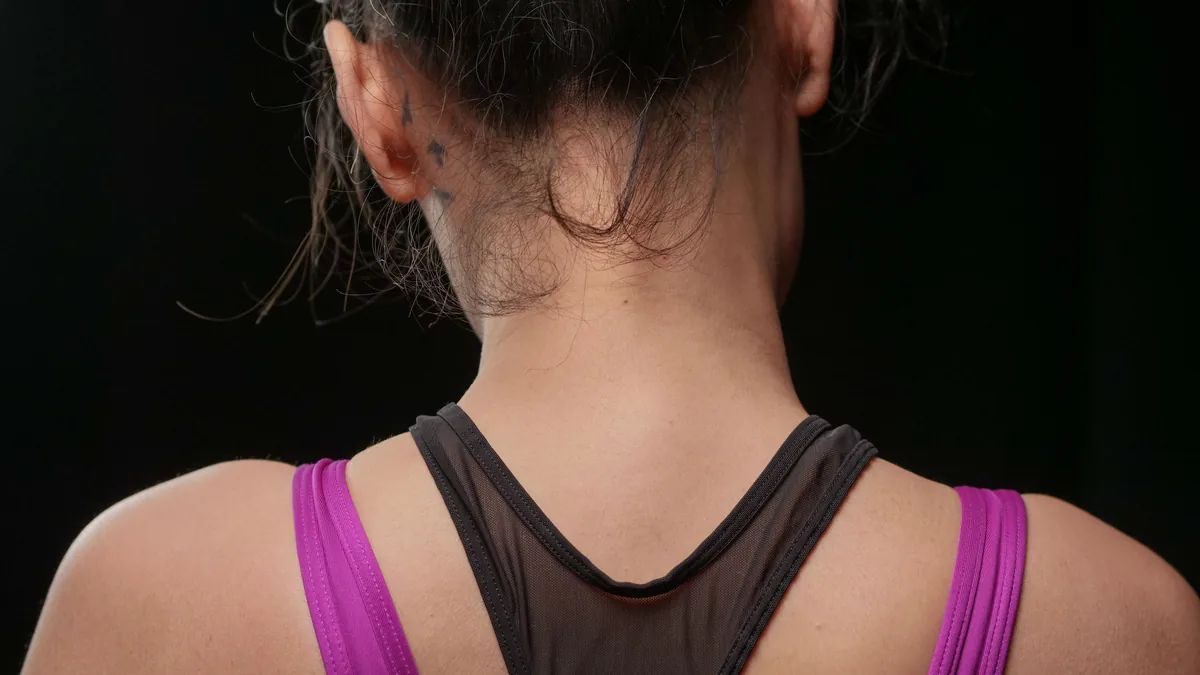
The greater occipital nerve, mostly from the C2 root, supplies the back of the head from the base of the skull up toward the crown. The lesser occipital nerve, from C2 and C3, runs further out and supplies the area behind and above the ear.
There is more than one occipital nerve, and they supply different areas. Which one is carrying your pain decides where the injection goes. Getting that wrong is one of the ordinary reasons a block does nothing.
What are the three occipital nerves?
- Greater occipital nerve. The main one, arising largely from the C2 nerve root. It comes out near the midline at the base of the skull. It supplies the back of the head from there up and over toward the crown. Most of what is meant by an occipital nerve block targets this nerve.
- Lesser occipital nerve. Arising from C2 and C3, running further out to the side. It supplies the area behind and above the ear. Pain that sits behind the ear rather than at the midline points here.
- Third occipital nerve. From C3, supplying a small area low at the back of the head. It carries particular significance because it also supplies the C2-C3 facet joint. That makes it relevant when the neck joints are the source — see is my headache coming from my neck.
Where do you feel occipital nerve pain?
Before your appointment, try tracing the pain with a finger rather than describing it. Pain running from the base of the skull up over the back of the head, sometimes reaching the top or behind the eye, follows the greater occipital nerve. Pain sitting behind and above the ear follows the lesser. Both can be involved at once, which is why blocks are sometimes done at both sites. How long that relief holds varies widely — see how long a block lasts.
This is also why one-sided pain in this pattern raises occipital neuralgia rather than migraine. That holds when it comes with tenderness over the nerve and a shooting or electric-shock quality — see occipital neuralgia or migraine.
How can a nerve at the back of the head cause pain behind the eye?
A neck nerve can cause pain behind the eye because of convergence. Sensory fibers from the upper cervical roots meet fibers from the trigeminal nerve, which supplies the face. They meet in the same region of the brainstem — the trigeminocervical complex. Signals from the back of the head are processed alongside signals from the front of it, and can be felt there.
That anatomy is why blocking a nerve at the back of the head can help a headache felt at the front. Otherwise it would make no sense at all.
The artery that changes the technique
The occipital artery runs alongside the greater occipital nerve. That single anatomical fact accounts for most of what is distinctive about doing this injection properly.
A landmark technique finds the nerve by measuring from bony points — typically along the line between the occipital protuberance and the mastoid process. It is a reasonable estimate of where the nerve usually is. But both the nerve and the artery vary in position between people. Ultrasound shows both in real time, with Doppler to tell vessel from nerve. It also shows the needle advancing. See ultrasound and fluoroscopic guidance.
So imaging is doing two jobs: keeping the injectate out of the artery — the main safety consideration, covered in side effects and risks — and making a negative result meaningful. Both matter — see why image guidance matters.
Why might an earlier occipital nerve block not have worked?
Say a past block was placed at the standard greater occipital site and did nothing. The useful question is not only whether it was guided, but whether it was aimed at the right nerve. Pain behind the ear treated with a midline greater occipital block is a plausible reason for a genuine non-response. That is a fixable problem, not evidence the approach does not work for you.
Common questions
Which occipital nerve is mine?
It is worked out from where you trace the pain and where the tenderness is, then confirmed by the response to blocking it. Bring a clear description, or trace it on yourself at the visit — contact us to arrange one.
Can both sides be blocked at once?
Yes, bilateral blocks are routine where the pain is on both sides. See occipital nerve block.
Why does blocking a nerve in my neck help pain behind my eye?
Because upper cervical and trigeminal sensory fibers converge in the trigeminocervical complex, so pain from the back of the head can be felt at the front. It is the same convergence that makes neck involvement so common in migraine — see is my headache coming from my neck.
Is the third occipital nerve blocked the same way?
It is a different and more precise target, and it is usually relevant when the C2-C3 facet joint is the suspected source — which is a cervicogenic picture. See cervicogenic headache treatment.
What does the greater occipital nerve do?
It carries feeling from the back of the head. Arising mostly from the C2 nerve root, it emerges near the midline at the base of the skull and supplies the scalp from there up and over toward the crown. It is the main occipital nerve, and most of what is called an occipital nerve block is aimed at it.
What is the difference between the greater and lesser occipital nerve?
They cover different ground. The greater occipital nerve, mostly from C2, supplies the back of the head from the base of the skull toward the crown. The lesser occipital nerve, from C2 and C3, runs further out to the side. It supplies the area behind and above the ear. Pain behind the ear points to the lesser nerve; pain at the midline points to the greater.
What does an irritated occipital nerve feel like?
Pain on one side that follows the nerve from the base of the skull up over the back of the head. It sometimes reaches the top of the head or behind the eye. There is often tenderness over the nerve and a shooting or electric-shock quality. That pattern points toward occipital neuralgia rather than migraine. The response to a guided block confirms which nerve is involved.
Sources
- Zhang H, Yang X, Lin Y, Chen L, Ye H. The efficacy of greater occipital nerve block for the treatment of migraine: a systematic review and meta-analysis. Clin Neurol Neurosurg. 2018;165:129-133. doi:10.1016/j.clineuro.2017.12.026
- Inan LE, Inan N, Karadaş Ö, et al. Greater occipital nerve blockade for the treatment of chronic migraine: a randomized, multicenter, double-blind, and placebo-controlled study. Acta Neurol Scand. 2015;132(4):270-277. doi:10.1111/ane.12393
Which occipital nerve is involved decides where the needle goes, and that is why it is placed under imaging. That precision is standard at our St. Louis headache clinic; see ultrasound and fluoroscopic guidance.