
When oxygen fails for cluster headache, check four things before you accept that it does not work for you: the mask, the flow rate, how early you started, and where the cylinder was. Most failures are one of those, not biology.
This matters because oxygen is the abortive with the best evidence in cluster headache and essentially no side effects. Writing it off wrongly costs you the best tool available.
1. The mask
The trial that established the effect used a face mask delivering 100% oxygen.1 A nasal cannula cannot deliver this treatment at any flow rate — you breathe room air around it. A simple face mask without a reservoir bag pulls in room air too. That dilutes the oxygen below what is needed.
What you need is a non-rebreather mask with a reservoir bag, fitted so it seals reasonably against the face. If the bag collapses on inspiration, the flow is too low.
2. The flow rate
Twelve liters per minute in the trial. Maybe you were sent home on two, three or four liters — the flow rates typical for chronic lung disease. If so, you were not given this treatment. That mismatch happens because oxygen prescriptions default to the respiratory use case. That is a completely different intervention with a completely different goal.
3. When you started
Oxygen is an abortive, and it works best from the first sign of an attack. Cluster peaks within minutes. Starting twenty minutes in, once the pain is established, is a materially different test from starting at onset.
4. Where the cylinder was
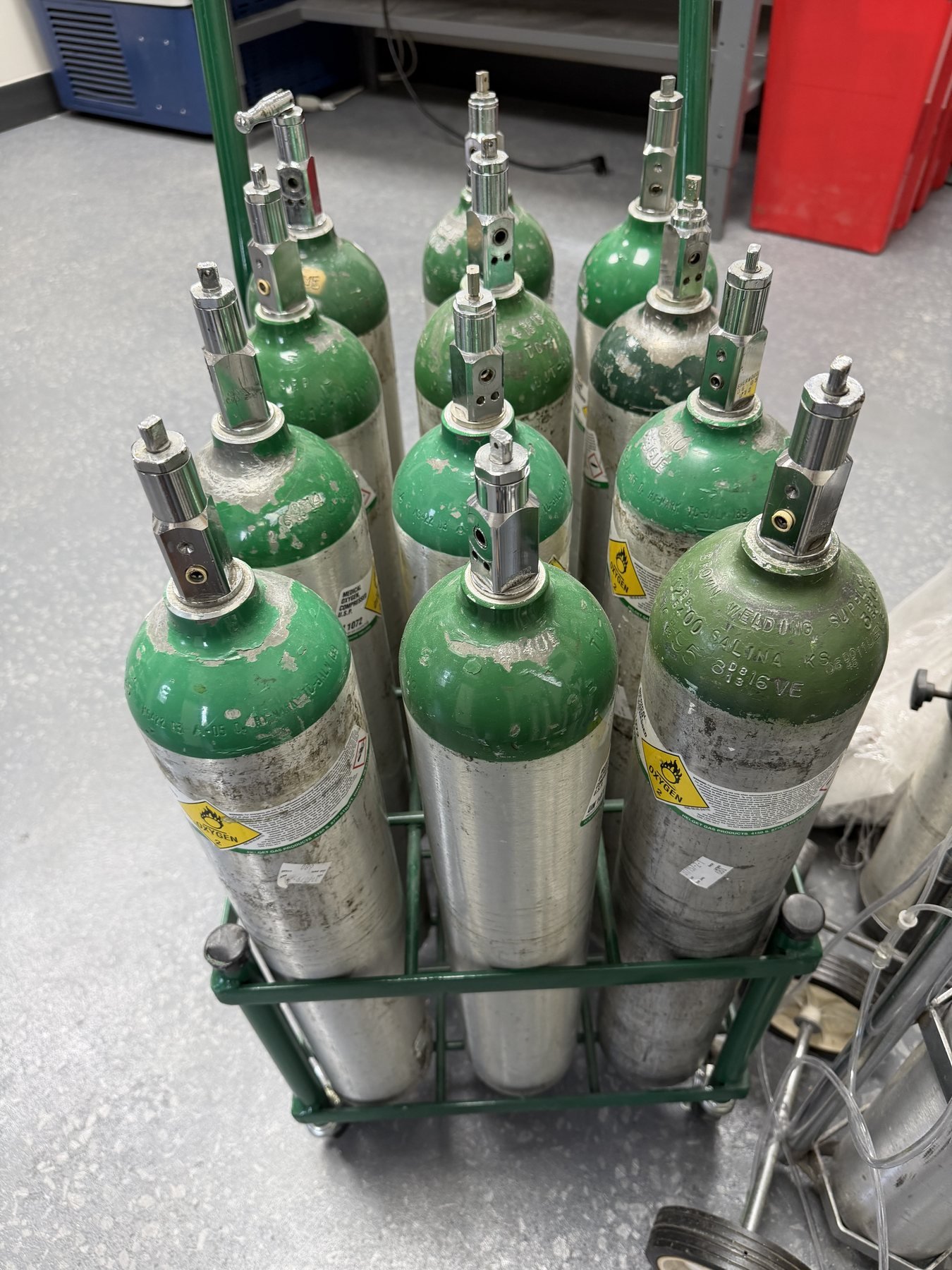
An abortive you cannot reach is not a treatment. Attacks that wake people at 3am are the classic case. The oxygen is in the front room, or at the clinic. By the time it is running, the attack has done most of its work. Home setup is part of the treatment, not an optional extra.
If all four were right
Then two questions remain. The first is whether the diagnosis is correct — oxygen is highly specific to cluster and related trigeminal autonomic headaches. It does not treat migraine. A genuine non-response to properly delivered oxygen is a reason to revisit whether this is cluster at all. Read migraine or cluster headache against your own attack pattern.
The second is that even in the trial, oxygen did not work for everyone. 78% reached the endpoint at 15 minutes. That means roughly one in five attacks did not respond.1 Some people genuinely are non-responders. For them, the plan moves to other abortives and to bout-shortening options such as a greater occipital nerve block or an SPG block.
What we do about it
We check the equipment before we check anything else, and we arrange a setup you can actually reach during an attack. See oxygen therapy and cluster headache treatment.
Dr. Gurpreet Singh Padda, MD, MBA, MHP has lived with chronic cluster headache since the age of 17. That is why the guidance here is unusually specific about flow rates and masks. The detail is the difference between a treatment that works in fifteen minutes and one more person concluding oxygen is useless.
Common questions
How do I know if my mask is the right one?
A non-rebreather has a reservoir bag hanging below it and one-way valves. If there is no bag, it is not a non-rebreather. If the bag deflates fully when you breathe in, the flow rate is too low. See oxygen therapy.
My oxygen was prescribed for my lungs. Can I use the same setup?
Usually not as-is. Respiratory oxygen is typically delivered by cannula at low flow, which cannot abort a cluster attack. The prescription for cluster is a different flow rate and a different mask — contact us to sort it out.
How long should I breathe it for?
The trial used 15 minutes. If the attack breaks sooner, you can stop. If there is no effect at all by 15 to 20 minutes with correct delivery, that is a genuine non-response worth reporting. See oxygen therapy.
Can I use it as often as I need?
There is no ceiling in the way there is with drug abortives, and no interactions to manage — which is one of its main advantages. Frequency of attacks is itself information about bout control. So tell us the count. See cluster headache treatment.
Will a can of store-bought oxygen stop a cluster attack?
No. A 15-minute treatment at the trial’s 12 liters a minute uses about 180 liters of 100% oxygen through a sealed non-rebreather mask. A retail can holds a few liters in total, released in short puffs through a cup you hold to your face, so room air makes up most of every breath. If a can is what you had, oxygen has not been tried yet. See what the high-flow oxygen trial showed.
When oxygen fails, the usual culprits are flow rate, mask and timing, and the next step is a nerve block rather than giving up. Both belong to our cluster headache care in St. Louis.
Sources
- Cohen AS, Burns B, Goadsby PJ. High-flow oxygen for treatment of cluster headache: a randomized trial. JAMA. 2009;302(22):2451–2457. jamanetwork.com